Manage your business
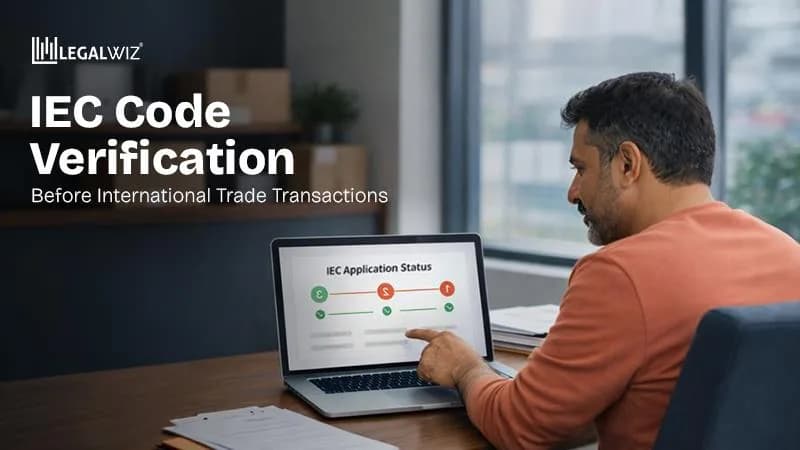
IEC Code Verification Before International Trade Transactions
International trade runs on documents, timelines, and trust. One missing detail can delay shipments or block payments.
2 min read

The ten digit code allotted by the DGFT, without which no shipment clears customs. One code per PAN, valid for every branch, and it never has to be applied for again.
A few details, then secure checkout. Your expert takes it from there.
Starting at₹2,299+ Govt. Fees
Prefer to talk to someone first?
What the code does, how long it lasts, and the one thing that has to be done with it every year.
The Importer Exporter Code is a ten digit code allotted by the Directorate General of Foreign Trade to businesses that import or export. Without it a consignment cannot be cleared, and the bank cannot process the payment on either side of the transaction.
It is a one-time registration. The code is issued against your PAN and covers every branch and every place of business under the same entity, so there is no separate application for a second location and nothing to re-apply for later.
What did change is that an IEC now has to be confirmed each year. Between April and June the details have to be updated online, even where nothing has changed, and a code that is not confirmed in that window is deactivated until it is. That is the one piece of upkeep it carries.
You share the documents once. The application, the filing and the follow-through are handled for you.
The code is permanent, but it has to be confirmed online between April and June each year. A code that is not confirmed in that window is deactivated.
Any movement of goods into or out of India for a commercial purpose.
Where the provider is claiming a benefit under the Foreign Trade Policy.
Customs will not release a commercial consignment without the code.
Import or export for personal use, and consignments moved by a government department or a notified charity, are outside the requirement.
Without an IEC a business cannot lawfully move goods or services across the border at all. It is the registration that opens the international market rather than one that improves your position in it.
The application is filed online against a small set of documents and the e-IEC is usually issued in three to four working days. It can be downloaded from the link sent to you as soon as it is granted.
Holding the code is what makes an exporter eligible for the schemes run by the DGFT, and for support from Customs and the Export Promotion Councils.
There are no returns to file and no renewal to apply for. The one thing the code does carry is an annual update between April and June, which takes minutes and without which the code is deactivated.
An IEC lets you trade across the border. It is not a tax registration, and it does not replace one. This is what each of the five actually obliges you to do.
| Attribute | Importer Exporter Code | GST Registration | Professional Tax | Shop & Establishment | MSME / Udyam |
|---|---|---|---|---|---|
| Do you have to register | |||||
| Importers and exportersAny business importing into or exporting out of India for commercial purposes. Import or export for personal use, and consignments moved by a government department or a notified charity, are outside it. | Suppliers over the thresholdAny business supplying goods with an aggregate turnover over ₹40 lakh, or services over ₹20 lakh. In the special category states those figures are ₹20 lakh and ₹10 lakh. Several categories have to register whatever their turnover. | Employers and professionalsAnyone earning from a salary, a trade or a profession in a state that levies the tax. An employer registers to deduct it from salaries; a professional or a business owner registers to pay their own. | Every commercial premisesShops, offices, hotels, restaurants, cafes, warehouses and places of public amusement. It attaches to the premises, not to a headcount, so a business with no employees still needs it. Factories are outside it, because they are covered by the Factories Act, 1948. | Micro, small and medium enterprisesAny enterprise within the investment and turnover limits for its class. Wholesale and retail traders were brought back in from 2021 and are eligible. | |
| Mandatory to tradeThere is no penalty for not holding an IEC. There is simply no import or export without one, and no way to clear a shipment. | Mandatory over the thresholdCompulsory once you cross the turnover limit or fall into a specified category. Below it, registration is voluntary, and many suppliers take it anyway to be able to pass on input tax credit. | Mandatory where leviedCompulsory in the states that have enacted it, and not applicable at all in the states that have not. An employer generally has to register within 30 days of taking on staff. | MandatoryCompulsory in most states within 30 days of the business being set up, and each branch registers separately whatever the jurisdiction. | VoluntaryNothing requires an enterprise to register. It is taken for what it unlocks: collateral-free lending, the protection against delayed payments, and the fee rebates. | |
| Who runs it | |||||
| DGFTThe Directorate General of Foreign Trade, under the Ministry of Commerce and Industry. One code per PAN, valid for every branch of the entity. | Central and stateAdministered jointly. On a sale within a state the tax splits into CGST for the centre and SGST, or UGST in a union territory, for the state. On a sale between states, IGST is levied instead. | State governmentEach levying state sets its own slabs and its own filing calendar, collected through the state commercial tax department or the municipal corporation. | State or municipalThe state labour department in most states, and the municipal corporation in some, including Maharashtra and Gujarat where it is issued as a Gumasta licence. | Ministry of MSMECentral, through the Udyam Registration portal. The registration draws turnover and investment figures from your PAN and GST records rather than from a declaration. | |
| Foreign Trade Act, 1992The Foreign Trade (Development and Regulation) Act and the Foreign Trade Policy. | CGST Act, 2017Together with each state’s own GST Act. | State Professions Tax ActsEnabled by Article 276 of the Constitution, which is also what caps the tax at ₹2,500 a year. | State Shops ActsA separate Shops and Establishments Act in each state, with its own rules. | MSMED Act, 2006The Micro, Small and Medium Enterprises Development Act, and the 2020 notification that replaced Udyog Aadhaar with Udyam. | |
| What you owe afterwards | |||||
| NoNo return is prescribed. See the row below, which is not the same thing. | YesMonthly or quarterly returns depending on turnover and the scheme you are in, plus an annual return. A registered person with nothing to report still files a nil return. | YesMonthly or annually, depending on the size of the liability and on the state’s own rules. | NoNo return, but registers of employment, wages, deductions, fines, leave and holidays have to be kept at the premises and produced on inspection. | NoNo return. The classification updates itself each year from the ITR and GST data filed against your PAN. | |
| LifetimeThe code itself is permanent and is never re-applied for. It can be surrendered, and it can be deactivated, as the next row explains. | PermanentThe GSTIN does not expire and is not renewed. A casual taxable person or a non-resident is the exception: theirs is issued for the period applied for, up to 90 days, and can be extended once. | PermanentHeld for as long as the business operates in the state. A separate registration is needed for each additional place of work. | Varies by statePerpetual in some states and issued for a fixed term in others, so the renewal cycle depends on where the premises is. Closing the business has to be notified within 15 days. | PermanentValid for as long as the enterprise exists, with no renewal. The class it sits in can move up or down as the figures change. | |
| Required, every yearAn IEC has to be updated or confirmed online between April and June each year, even where nothing about the business has changed. An IEC that is not confirmed is deactivated, and it stays deactivated until it is updated. | Not requiredNothing is confirmed; the returns do that job. | Not requiredNothing is confirmed separately; the returns and the payments do that job. | Not requiredNothing is confirmed yearly, though a state that issues a fixed-term certificate expects a renewal before it expires. | Not requiredNothing to file. Linking your PAN and GSTIN at registration is what keeps the classification current. | |
| Next step | Get started | Know more | Know more | Know more | Know more |
Swipe the table sideways, Importer Exporter Code stays in view. Open any attribute to read the detail behind all 5 answers.

Excellent service
Personal experience with Legalwiz is excellent. A trustworthy company
I highly recommend LEGALWIZ for anybody who is planning to establish a company in India. The professionalism they displayed made me more attracted to them. let me use this opportunity to commend Ms. Garvi and Namita, I say a big thank you to them and all the staffs. LEGELWIZ is second to none.
Very good service in a specified time.
Pooja Satyawadi was so convincing in her approach, made me to take a decision and pay the fee in a few minutes and significantly obtained the registration in a few hours Best of Luck to her
100% satisfied result .tnx legalwiz
Great service, always quick and accurate.
Legalwiz is an awesome bridge to apply for licenses and others you guys totally simplify our work.
Five documents, and fewer than that for an individual applicant.
A scanned copy of the PAN of the applicant, or of the company.
For a company or a partnership, the PAN of a director or partner is also required.
A sale deed, rent agreement, recent electricity bill or telephone bill in the name of the applicant.
A cancelled cheque of the current account showing the entity’s pre-printed name, or a bank certificate in form ANF-2A(i).
The incorporation certificate with the MoA and AoA, the LLP agreement or the partnership deed, whichever applies.
Step 01
Step 02
Step 03
Subject to government processing time.
Three to four working days from the day the documents reach us.
1 of 4 working days
2 of 4 working days
2 of 4 working days
Subject to government processing time.
Leverage best deals offered by the industry leaders and experience mutual growth.










Still have a question? Our team is happy to help, at no charge and with no obligation to buy anything.
Registration is required in two situations:
No. It is not needed for:
Yes. An IEC has to be updated or confirmed online between April and June each year, even where nothing about the business has changed.
An IEC that is not confirmed in that window is deactivated, and it stays deactivated until the update is filed. This is a change from how the code used to work and it is easy to miss, because nothing about the code itself expires.
The code itself is valid for life unless it is surrendered or withdrawn. Once it is allotted there is no re-registration.
That is separate from the yearly confirmation above, which is about keeping the code active rather than about the code expiring.
Yes. Any individual importing or exporting goods or services for the purpose of business can apply, by filing the online application with the documents required.
Where the applicant has no current account for the business, a cancelled cheque of a savings account can be provided instead.
No. The registration is against your PAN, so a single code covers every business and every branch of the same entity.
No. Only a single code is issued against a PAN. If more than one has been issued, the extra has to be surrendered to the regional office.
There is no penalty as such. There is simply no import or export without it, and no way to clear a consignment.
Yes. The details can be modified after the code has been issued, on providing the documents supporting the change.
No. The DGFT has integrated the PAN web service of the CBDT with its own system, so the card is not uploaded with the application.
A copy is still needed by the team preparing the application.
International trade runs on documents, timelines, and trust. One missing detail can delay shipments or block payments.
2 min read

Starting a business through a franchise model suits entrepreneurs who want structure, brand continuity, and a proven business system.
9 min read
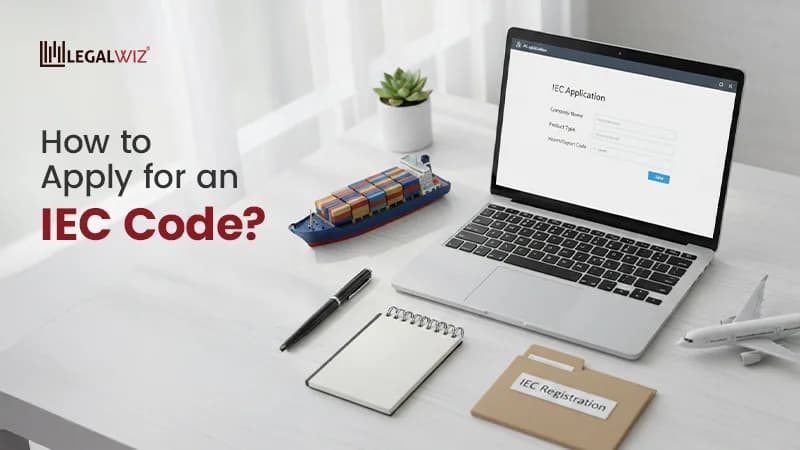
When you’re ready to take your business beyond India and tap into global markets, the very first requirement is to understand how to apply for IEC code and complete your import export code registration.
6 min read
One application, one code, and every branch of the business covered.
Get started