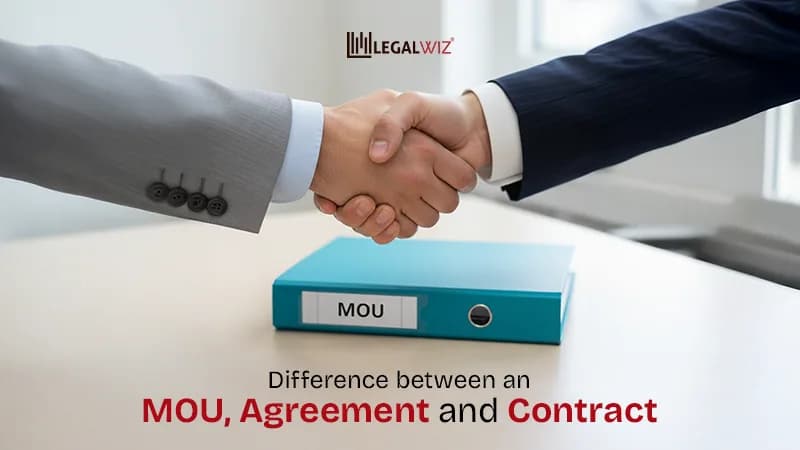
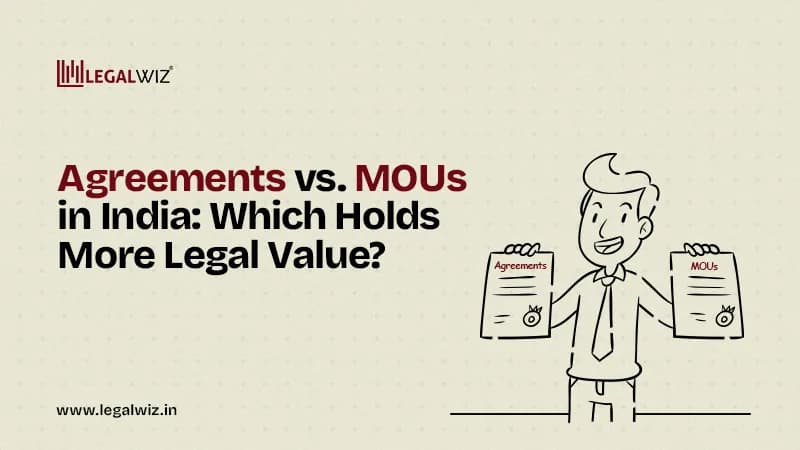
Difference Between MOU, Agreement and Contract
In business and legal dealings, paperwork often appears before clarity does. MOUs, agreements, and contracts are not interchangeable, and choosing wrong one can leave you unprotected.
5 min read
The formal record of an intention two parties share, before there is a contract. It is meant not to bind, and it only reliably does not bind if it says so.
A few details, then secure checkout. Your expert takes it from there.
Prefer to talk to someone first?
A formal agreement between two or more parties expressing a shared intention and a common line of action.
A memorandum of understanding, usually shortened to MoU, is a formal agreement between two or more parties. It expresses a convergence of will between them and indicates an intended common line of action.
It carries a degree of seriousness and mutual respect stronger than a gentlemen’s agreement, and it is often the first step towards a legal contract. If you agree to buy a house but can only pay for it in six months, you might sign an MoU with the seller recording that, and pay a small advance now, with the legal paperwork to follow.
It is usually described as not legally binding, and that is the intention behind it. Whether it actually binds depends on what it says: an MoU with definite terms and no statement to the contrary can be enforced as a contract. Which is why a well-drafted one says plainly which parts bind and which do not.
The commonest fault in an MoU is that it is silent about its own effect. That silence is what lets a party argue later that the whole thing was a contract.
You are about to exchange information while you work out whether to do the deal. That obligation should bind from the day the MoU is signed, whatever happens next.
A period during which neither side talks to anybody else. It is worth having and it is worth being binding, because an exclusivity nobody has to honour is not one.
Due diligence, advisers, travel. Agreeing this while everyone is enthusiastic is far easier than agreeing it if the deal falls over.
One clause saying that nothing else in the document creates a legal obligation. It is the clause the whole MoU depends on.
Two sides who have negotiated for weeks rarely remember the same thing. An MoU is the written version they both signed.
It carries a degree of seriousness and mutual respect well beyond a gentlemen’s agreement, without committing either side to perform.
The confidentiality and exclusivity clauses do bind, which means the exchange of information that follows is safe even if the deal does not happen.
A contract drafted from a signed MoU starts from an agreed position rather than a blank page, which is faster and cheaper for everyone.
Three words used interchangeably for three different things. Choosing the wrong one leaves you either unprotected or committed to something you thought was a discussion.
| Attribute | MoU | Agreement | Contract |
|---|---|---|---|
| What each one is | |||
| An intentionA convergence of will between the parties, and the common line of action they intend to take. | A mutual understandingA meeting of minds on something. Every contract is an agreement; not every agreement is a contract. | Enforceable promisesAn agreement that the law will enforce, because it has the ingredients a contract needs. | |
| Intended not to beAnd it should say so expressly. An MoU with definite terms and no such statement can be enforced as a contract, which is the trap. | Only if it qualifiesAn agreement becomes enforceable when there is an offer, an acceptance, lawful consideration, capacity and an intention to create legal relations. | YesThat is what makes it a contract. A party in breach can be sued on it. | |
| When to use which | |||
| Before the dealWhile the parties are still working out whether there is a deal, and want the position recorded and the conversation protected. | Loosely, for anythingIn practice "agreement" is the word people use for any signed document. What matters is whether it has the ingredients of a contract, not what it is titled. | When you commitWhen both sides intend to be bound and want a remedy if the other does not perform. | |
| A record and a protected conversationPlus the confidentiality and exclusivity that were drafted to bind. No obligation to complete the deal. | It depends on the documentWhich is exactly why the word on the cover is not the thing to rely on. Read what is inside it. | A right to performanceOr to damages instead. This is what you actually want at the point where money is changing hands. | |
| Next step | Get started | ||
Swipe the table sideways, MoU stays in view. Open any attribute to read the detail behind all 3 answers.
Leverage best deals offered by the industry leaders and experience mutual growth.


Still have a question? Our team is happy to help, at no charge and with no obligation to buy anything.
It is intended not to be, and a well-drafted one says so expressly. That statement is what makes the position reliable.
An MoU with definite terms, consideration and no statement about its effect can be enforced as a contract. "It is only an MoU" is not a defence on its own.
Yes, and that is how a good MoU is drafted. Confidentiality, exclusivity and costs bind; the commercial intention does not.
It depends on the state and on what the document does. Where it records a transaction that attracts duty, it may.
We confirm the position for your state as part of the drafting rather than assuming it either way.
Very little in Indian practice: both record a pre-contractual position, and both raise the same question about what binds.
A letter of intent is usually one-sided in form, addressed by one party to the other; an MoU is signed by both.