Government Tax Registrations
GST Registration Threshold Limits for Goods and Services Providers
GST registration is not mandatory for every business from the start.
4 min read

File the Letter of Undertaking and export without paying tax first. It is valid for one financial year, and it has to be filed again before the next one begins.
A few details, then secure checkout. Your expert takes it from there.
Starting at₹2,600+ Govt. Fees
Prefer to talk to someone first?
What the undertaking says, what it saves you, and the deadline that decides whether it saves you anything at all.
A Letter of Undertaking, or LUT, is filed by an exporter so that goods or services can go out without paying tax on them. Exports are zero-rated either way; the LUT is about which of the two routes to zero-rating you take.
Without one, you export on payment of IGST and then claim the tax back as a refund. That works, but the money is out of the business for as long as the refund takes, and the refund process is a good deal more involved than the undertaking is. By filing the LUT you undertake instead to meet the conditions the route requires, and pay nothing up front.
It is filed online in form GST RFD-11 and it is valid for the financial year in which it is filed. To keep exporting tax-free into the next year, the LUT has to be filed again before that year starts. The eligibility rules are also far more relaxed than they used to be: the old turnover and inward-receipts conditions are gone, and any exporter willing to export without paying tax can file one.
The undertaking is a legal document executed on stamped paper, not a form. It is drafted and executed before anything is submitted.
The LUT covers only the financial year in which it is filed. Filing for the next year has to be done before that year begins, or exports made in the meantime carry IGST which then has to be claimed back as a refund.
The goods or services go out with no tax paid. Nothing leaves the business and nothing has to be reclaimed.
IGST is paid on the export first and then claimed back. The tax is out of the business until the refund is processed.
The refund route ties up working capital on every consignment and adds a claim to make each time. For a regular exporter the difference compounds.
Exports are zero-rated on both routes. The only thing that differs is whether the money leaves the business in between.
With the undertaking on file, goods and services go out with no tax paid on them. Without it, the tax is paid on export and then reclaimed to get to the same zero-rated position.
The refund route blocks a real amount of capital for as long as the claim takes to process. With the LUT that money is available for the business instead, and the cost of exporting comes down with it.
Once filed, the undertaking runs for the rest of that financial year. There is nothing to repeat per consignment, unlike the refund route where every export carries its own procedure.
Both the filing and the acceptance have been online since 2018. Nobody visits an officer, and the ARN on the acknowledgement is itself the acceptance.

Thank you for a rapid response & good work done!
Thank you for a fast & professional service!
Till date, it is a very good experience with the team, especially Ms. Pooja & Ms. Krishna done their jobs very nicely. Thanks to the entire team for their support.
Six items. The witnesses are the one people are usually not expecting, so it is worth arranging them early.
A copy of the PAN card of the exporting entity.
A copy of the PAN and Aadhaar of the partners or directors.
The details of at least two witnesses, with their address proof and PAN.
The GST registration certificate of the exporter.
The Importer Exporter Code certificate.
A copy of a cancelled cheque of the exporter’s current account.
Step 01
Step 02
Step 03
Subject to government processing time.
Three to five working days, most of which is drafting and execution.
2 of 5 working days
2 of 5 working days
1 of 5 working days
Subject to government processing time.
Leverage best deals offered by the industry leaders and experience mutual growth.












Still have a question? Our team is happy to help, at no charge and with no obligation to buy anything.
On either of two routes. Exports can be made on payment of the applicable GST, with the tax then refunded subject to the conditions of export, or without payment of tax at all.
The second route is the one the Letter of Undertaking opens.
A first LUT can be filed at any point before you export without tax.
To carry the arrangement into the next financial year it has to be filed before that year begins. This is the deadline people miss, and missing it means exports in the meantime go out with IGST paid.
Any exporter willing to export without paying tax.
The turnover and inward-receipts conditions that used to apply have been removed, so the eligibility is far wider than it was when the route was introduced.
No. The requirement to furnish a bond has been removed. For exports without payment of tax the online Letter of Undertaking is what is filed.
Online, on the GST Network portal, using your GST credentials. It has been filed this way since the 2018-19 financial year.
The undertaking itself is executed on duly stamped paper and then submitted through the portal.
The whole of the financial year in which it is filed.
It can lapse earlier: where the conditions attaching to the exports are not met, the LUT is deemed withdrawn until they are.
No. The ARN generated on the acknowledgement is itself deemed to be acceptance of the LUT, so there is no physical submission and no visit to an officer.
Yes. It is valid only for the financial year in which it is filed, so it is applied for at the start of every financial year.
GST registration is not mandatory for every business from the start.
4 min read
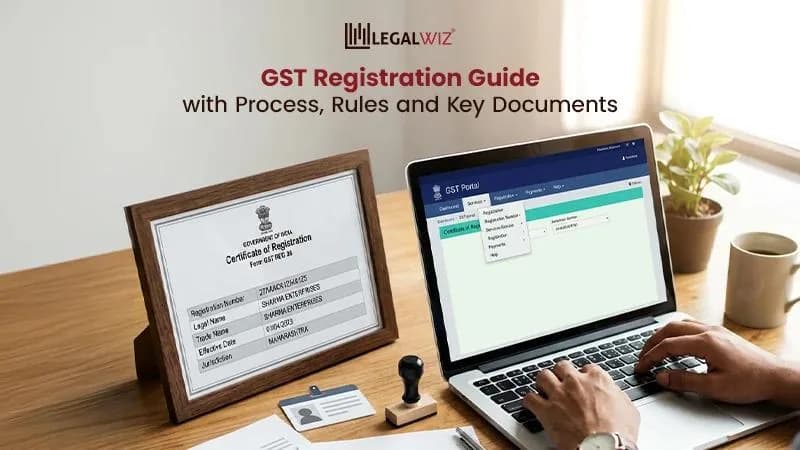
Getting a GST registration is the first step to running a business in India with full compliance.
9 min read
Goods move in every direction, and every country sets its own rules to keep this movement steady.
6 min read
Get it on file before the financial year turns, and export without paying tax first.
Get started