Trademark
Trademark Objection vs Opposition Difference
Both can hold up your application. One comes from the Registry, the other from an outsider, and you reply to them very differently.
4 min read

A registered trademark lasts 10 years, and renewing it keeps your rights active for another 10. LegalWiz.in handles the application, the documents and the filing.
A few details, then secure checkout. Your expert takes it from there.
Starting at₹3,899+ Govt. Fees
Prefer to talk to someone first?
When a renewal is due, what happens if it is missed, and why founders choose LegalWiz.in to file one.
A registered trademark in India expires after 10 years. Renewing it, online or offline and with the renewal fee, extends it for another 10, and there is no limit on how many times that can be done. A trademark can therefore be kept permanently, which no other intellectual property right allows.
The renewal application should be filed on or before the six months preceding the expiry date. The Registry sends the owner a notice about the expiry, the fee and the conditions before that point.
If the date passes, the mark is removed from the register and anyone else can claim it and register it in their own name. There is a six-month grace period after expiry in which the mark can still be restored, with additional fees and more documentation.
Everything below is handled by your relationship manager and a registered attorney. You supply the registration certificate and the documents once.
Government fees are charged at actuals. An application made after the expiry date attracts an additional fee.
The renewal application cannot be made earlier than one year before the 10-year term ends.
Filing about six months ahead leaves room for the Registry’s processing without running at the deadline.
The Registry can condone a delay of up to six months after expiry. The application is still possible, with an additional fee.
A renewed mark makes it impossible for anyone other than the owner to claim rights over it, which is what keeps the protection seamless and keeps disputes from starting.
Exclusive rights over the mark run for another 10 years with each renewal, so protection against infringement of the brand name and the goodwill behind it continues indefinitely.
Renewal is what makes protection continuous and unbroken. A failure to renew is a lapse in the legal protection of the brand name, and the register is public.
A trademark owner has the exclusive right to assign or license the mark for a consideration. That right, and the value it carries, only exists while the registration is live.

Had a great experience with LegalWiz for my trademark registration. The service was smooth, and the after sales support was excellent. Although the filing took around 3 days, the team stayed connected throughout, provided clear updates, and there were no communication issues. Overall, a very professional and reliable experience.
Had a wonderful experience. The team was very supportive, responsive and completed everything on time. Thank you for the excellent support.
Jignesh was very helpful and amazing while filling the compliance form for my business. Will take your service again.
Good support team. No hindrance in executions. Go for it.
JIGNESH BHAI, I wanted to take some time to sincerely thank you for your incredible support with my MSME registration through LegalWiz. From start to finish, Jignesh Bhai, your guidance, patience, and professionalism made what could have been a stressful and confusing process feel completely smooth and manageable. You took the time to explain every step clearly, answered all my questions patiently, and ensured that nothing was left uncertain. Your attention to detail and dedication truly stood out, and it gave me a lot of confidence throughout the process. I really appreciate the effort, care, and commitment you put into helping me. Jignesh Bhai, your service has been exceptional, and I couldn’t have asked for a better experience. Heartfelt thanks once again!
Highly recommend services from Legalwiz. Got my LLP conversion process faster. Helpful staff.
Limited Liability PartnershipHad a great experience working with the team! They handled my LLP registration smoothly, guided me clearly through every step, and were always quick to respond. Really appreciate their professionalism and support. Highly recommended!
They are so quick and highly professional and experienced in the industry to carry out the requirement. Loved their services.

Trademark RegistrationVery fast & timely service. The team was very helpful and helped me find out if the brand name was available or not over the call itself without any extra cost or charge. Brilliant service, very clear communication, timely delivery & transperant pricing. Cheers!
Trademark RegistrationSatisfied with your unit service and fee grateful to connect with you service providers staff thanks regards Shivlal
File INC-20AI am very much satisfied with their service for INC 20 A. i will recommend them and definitely will keep in mind for any other service.
Close a Private Limited Companyexcellent, i appreciate accountability and transparency in the process
Private Limited CompanyLegalwiz is doing its best to give good service to clients.
Trademark RegistrationRecently got Trade Mark registered
Trademark RegistrationIt was an amazing experience from the support team. Thank you...
GST RegistrationHad a Seamless Experience in registering for GST. Been associated with them for 5 yrs now, and have done several LLP and GST registrations. Happy with their service, so i keep coming back.
Scanned copies are enough to begin. Your relationship manager will tell you if anything needs to be re-shared in a clearer format.
PAN card and address proof. An applicant that is not an individual also provides its certificate of registration.
The trademark registration certificate issued by the Registry.
The document that allows the attorney to file the renewal application on your behalf.
The original application filed with the Registry when the mark was registered.
Step 01
Step 02
Step 03
Subject to government processing time.
Three to four working days from your certificate to a filed renewal application.
1 of 4 working days
2 of 4 working days
1 of 4 working days
Subject to government processing time.
Leverage best deals offered by the industry leaders and experience mutual growth.








Still have a question? Our team is happy to help, at no charge and with no obligation to buy anything.
An application for renewal can be made no earlier than one year before the 10-year term expires. Applying about six months before the expiry date is ideal.
An application made after the 10 years have expired can only be filed with an additional fee.
Yes, within limits. The Registry may condone a delay of up to six months after the 10-year term ends.
A renewal application filed in that window is accepted on payment of additional fees.
The renewal application is made online through a registered trademark attorney, with the renewal fee and any additional or late fee that applies. It can be filed from six months before the expiry date.
Before the mark expires the registrar sends the owner a notice about the expiry, the renewal fee and the conditions. If it lapses, the mark is removed from the register, and a six-month extension period after expiry is available with a late fee.
You can apply to restore an expired trademark within six months of the expiry date and carry on using it.
Leaving it that late is a risk: restoration attracts additional fees and more documentation than a renewal filed on time.
Severe ones. The trademark is removed from the register.
Once it is off the register, any other person can claim the name and get it registered to themselves.
Registration is the initial process that establishes exclusive ownership of a mark. It takes more documents and considerably more time.
Renewal simply continues that ownership and the right to use the mark, and it is due at the end of every 10-year term.
No. Renewal makes no change to the rights of the trademark holder.
For as long as the trademark is valid, the holder enjoys every right they acquired at the original registration.
No. Trademarks are territorial and are valid only in the country they are filed in.
Protection elsewhere needs a separate registration in each country, or an application through an international route such as WIPO.
Both can hold up your application. One comes from the Registry, the other from an outsider, and you reply to them very differently.
4 min read
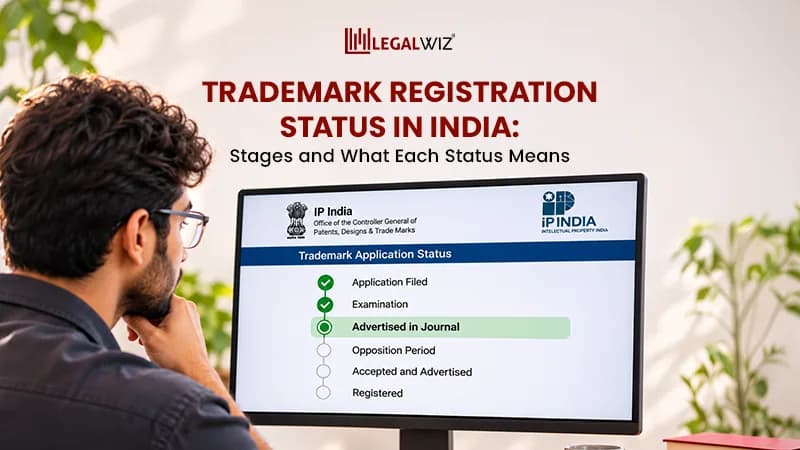
From Formalities Chk Pass to Registered, here is what each status on the IP India portal means and what you need to do next.
5 min read

If you offer services related to business consulting, digital marketing, advertising, or accounting, your brand belongs under Trademark Class 35.
5 min read