Trademark
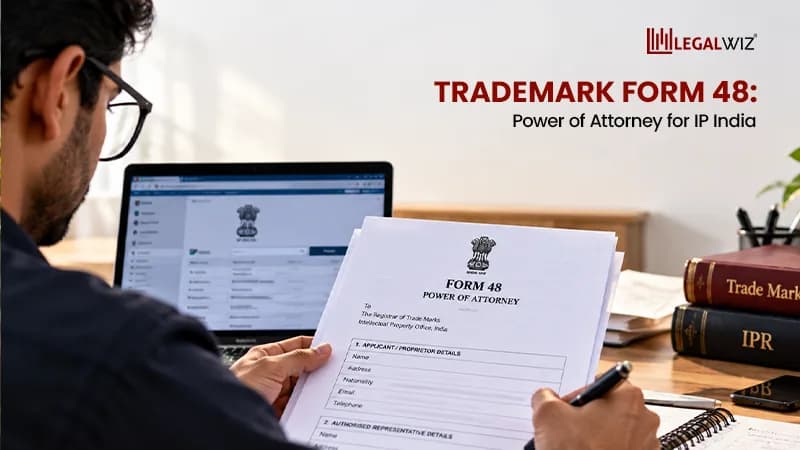
Trademark Form 48: Power of Attorney for IP India
Why your trademark agent needs this authority on record before anything gets filed, and what the Registry expects today
4 min read

The written authority for one person to act for another. Its power comes entirely from how it is worded, which is why the difference between a general and a special one is the first thing to settle.
A few details, then secure checkout. Your expert takes it from there.
Prefer to talk to someone first?
A written authorisation for one person to represent or act on another’s behalf in private, business or legal matters.
A power of attorney, sometimes called a letter of attorney, is a written authorisation to represent or act on another person’s behalf in private affairs, business, or some other legal matter. The person granting the authority is the principal, grantor or donor of the power; the person receiving it is the attorney or agent.
With a power of attorney you can give somebody the ability to write cheques, sign official documents and handle other legal matters on your behalf. It is used where you are not available, where you fall ill suddenly, or where you simply want someone to act for you in a specific situation.
There are different forms of it, and choosing between them is the first decision. A general power of attorney grants broad authority across your affairs; a special power of attorney grants authority for one defined purpose and ends when that purpose is served.
A power of attorney is only as narrow as its wording. Anything the document does not restrict, it permits.
Broad authority across your affairs: banking, property, litigation, business. Useful when you are going to be away or unreachable for a period, and dangerous when granted for a single transaction.
Authority for one defined purpose: selling a named property, appearing in one case, operating one account. It ends when that purpose is served, and it is what most people actually need.
If the task is specific, grant a special power. A general power granted for a single property sale authorises the holder to deal with everything you own, and that is how these go wrong.

Had a great experience with LegalWiz for my trademark registration. The service was smooth, and the after sales support was excellent. Although the filing took around 3 days, the team stayed connected throughout, provided clear updates, and there were no communication issues. Overall, a very professional and reliable experience.
Had a wonderful experience. The team was very supportive, responsive and completed everything on time. Thank you for the excellent support.
Jignesh was very helpful and amazing while filling the compliance form for my business. Will take your service again.
Good support team. No hindrance in executions. Go for it.
JIGNESH BHAI, I wanted to take some time to sincerely thank you for your incredible support with my MSME registration through LegalWiz. From start to finish, Jignesh Bhai, your guidance, patience, and professionalism made what could have been a stressful and confusing process feel completely smooth and manageable. You took the time to explain every step clearly, answered all my questions patiently, and ensured that nothing was left uncertain. Your attention to detail and dedication truly stood out, and it gave me a lot of confidence throughout the process. I really appreciate the effort, care, and commitment you put into helping me. Jignesh Bhai, your service has been exceptional, and I couldn’t have asked for a better experience. Heartfelt thanks once again!
Highly recommend services from Legalwiz. Got my LLP conversion process faster. Helpful staff.
Limited Liability PartnershipHad a great experience working with the team! They handled my LLP registration smoothly, guided me clearly through every step, and were always quick to respond. Really appreciate their professionalism and support. Highly recommended!
They are so quick and highly professional and experienced in the industry to carry out the requirement. Loved their services.

Trademark RegistrationVery fast & timely service. The team was very helpful and helped me find out if the brand name was available or not over the call itself without any extra cost or charge. Brilliant service, very clear communication, timely delivery & transperant pricing. Cheers!
Trademark RegistrationSatisfied with your unit service and fee grateful to connect with you service providers staff thanks regards Shivlal
File INC-20AI am very much satisfied with their service for INC 20 A. i will recommend them and definitely will keep in mind for any other service.
Close a Private Limited Companyexcellent, i appreciate accountability and transparency in the process
Private Limited CompanyLegalwiz is doing its best to give good service to clients.
Trademark RegistrationRecently got Trade Mark registered
Trademark RegistrationIt was an amazing experience from the support team. Thank you...
GST RegistrationHad a Seamless Experience in registering for GST. Been associated with them for 5 yrs now, and have done several LLP and GST registrations. Happy with their service, so i keep coming back.
Leverage best deals offered by the industry leaders and experience mutual growth.












Still have a question? Our team is happy to help, at no charge and with no obligation to buy anything.
A general power grants broad authority across the principal’s affairs. A special power grants authority for one defined purpose and ends when that purpose is served.
Where the task is specific, a special power is almost always the right choice, because it limits what can be done with the document if it falls into the wrong hands.
Stamp duty is payable at the rate the state sets, and notarisation is generally expected, because banks, registrars and courts usually ask for a notarised document.
Both are confirmed for your state as part of the drafting rather than assumed.
Some property-related powers have to be registered, and the position varies with the state and with what the power authorises.
It is worth settling before the document is executed, because a power that should have been registered and was not is one a sub-registrar will refuse to act on.
It can be revoked by the principal, it ends when the purpose it was granted for is served, and it is generally revoked by the death or insolvency of the principal.
Where you want the authority to survive your incapacity, say so on the call. That has to be dealt with deliberately in the drafting rather than assumed.
Yes, and it is common. A power executed abroad usually has to be attested at an Indian mission or apostilled, and then stamped in India within a period of it arriving.
Tell us where the attorney is on the call, because it changes how the document is executed.
Why your trademark agent needs this authority on record before anything gets filed, and what the Registry expects today
4 min read

Choosing the right business structure is an early decision with long-term consequences. It affects how risk is shared, who controls decisions, and what happens when things go wrong.
4 min read

The dictionary definition of a Disclaimer is a statement that denies something, in most cases a responsibility.
4 min read
The right form, with the powers written no wider than they need to be.
Get started