Business Registrations
How to Reopen or Restore a Struck-Off Private Limited Company in India
Imagine you registered a private limited company a few years ago, but it was stricken off the records due to paperwork or commercial slowdown.
6 min read

Every LLP registered in India has to file its annual returns and statement of accounts whether or not it trades. Striking the name off the register is the way to stop that, without a liquidator or a Tribunal.
A few details, then secure checkout. Your expert takes it from there.
Starting at₹8,899+ Govt. Fees
Prefer to talk to someone first?
The two ways out, the three conditions a strike-off requires, and why LLPs choose LegalWiz.in to handle the closure.
An LLP is a separate legal entity, created by following a legal procedure, so closing it means following one too. It can be closed by winding it up, or by striking its name off the Register of LLPs.
Winding up can be a costly and time-consuming affair, because it involves approval from the Tribunal and the appointment of a liquidator. So an LLP that has been non-operative since its formation, or for more than a year, generally takes the easier route out: a strike-off.
The LLP is declared struck off after the Ministry publishes its notice, and from that point it ceases to exist in the eyes of the law. The reason to do it rather than leave a dormant LLP in place is that the statutory cost of maintaining one is higher than the cost of winding it up. An LLP that has never opened a bank account or commenced business still has to make its filings every year to stay compliant and avoid penalties.
Your relationship manager and the drafting team handle everything below. You supply the documents once and execute the affidavit and the indemnity bond.
Government fees are charged at actuals. The stamp duty and the notary on the affidavit and the indemnity bond are completed by you in your own state or city, and the application has to be made within 30 days of the date the statement of assets and liabilities is prepared.
The LLP must have discontinued its operations for a minimum period of one year, or never have commenced business at all.
The LLP has to be fully compliant with its annual compliance requirements and everything else that applies to it.
Every bank account opened in the name of the LLP has to be closed. This is the condition that most often holds an application up.
Where the LLP has assets and liabilities, they have to be distributed and paid first, and the statement certified by a practising chartered accountant.
The statutory cost of maintaining an LLP is higher than the cost of winding it up. Where an LLP is dormant it is better to wind it up than to keep meeting compliances for a business that is not trading.
Every LLP registered in India has to file its annual returns and statement of accounts for each financial year, whatever its revenue or profit and regardless of whether it is working. An LLP that has never opened a bank account or commenced business still owes those filings each year.
The route is decided by what is still on the LLP’s books. Open any row to read the detail behind both answers.
| Attribute | Striking off | Winding up |
|---|---|---|
| Which route applies | ||
| A dormant entityThe fast-track route, for an entity that has stopped trading and has little or nothing left on its books. | An operating entityThe route for an entity that is still operative and has assets to realise and liabilities to settle. | |
| One yearThe LLP must have carried on no business since incorporation, or have ceased to operate, with a year having passed either way. | Not requiredWinding up is available whether or not the entity has traded. It is the route for one that has. | |
| Must be nilEvery liability has to be repaid or extinguished and the books closed before the application goes in. | Realised and settledAssets are sold and the proceeds applied against the liabilities as part of the process itself. | |
| What it involves | ||
| Not appointedNo liquidator and no application to the Tribunal, which is the main reason this route is faster and cheaper. | RequiredA liquidator is appointed to manage the affairs of the entity for the whole of the process. | |
| Partners and creditorsThe consent of the partners, plus a no objection certificate from any secured creditor and from the authority regulating the LLP, where one applies. | Members, directors, creditorsApproval is needed from all three, and the Tribunal is involved where the winding up is compulsory rather than voluntary. | |
| LLP Form 24Filed online with the Registrar of Companies (LLP). | Depends on the routeA voluntary winding up and one ordered by the Tribunal follow different procedures and different forms. | |
| What to expect | ||
| LowerNo liquidator to pay and fewer filings. For a dormant entity the cost of the exit is usually less than another year of keeping it compliant. | HigherThe liquidator, the valuations and the longer schedule each carry a cost. | |
| About 90 daysCounted from the date the application reaches the Ministry. The Registrar then publishes a notice inviting objections before the name is removed. | Considerably longerIt is a time-consuming process and no reliable figure can be put on it in advance. Your relationship manager will estimate it against your own books. | |
| Next step | Get started | |
Swipe the table sideways, Striking off stays in view. Open any attribute to read the detail behind both answers.

Had a great experience with LegalWiz for my trademark registration. The service was smooth, and the after sales support was excellent. Although the filing took around 3 days, the team stayed connected throughout, provided clear updates, and there were no communication issues. Overall, a very professional and reliable experience.
Had a wonderful experience. The team was very supportive, responsive and completed everything on time. Thank you for the excellent support.
Jignesh was very helpful and amazing while filling the compliance form for my business. Will take your service again.
Good support team. No hindrance in executions. Go for it.
JIGNESH BHAI, I wanted to take some time to sincerely thank you for your incredible support with my MSME registration through LegalWiz. From start to finish, Jignesh Bhai, your guidance, patience, and professionalism made what could have been a stressful and confusing process feel completely smooth and manageable. You took the time to explain every step clearly, answered all my questions patiently, and ensured that nothing was left uncertain. Your attention to detail and dedication truly stood out, and it gave me a lot of confidence throughout the process. I really appreciate the effort, care, and commitment you put into helping me. Jignesh Bhai, your service has been exceptional, and I couldn’t have asked for a better experience. Heartfelt thanks once again!
Highly recommend services from Legalwiz. Got my LLP conversion process faster. Helpful staff.
Limited Liability PartnershipHad a great experience working with the team! They handled my LLP registration smoothly, guided me clearly through every step, and were always quick to respond. Really appreciate their professionalism and support. Highly recommended!
They are so quick and highly professional and experienced in the industry to carry out the requirement. Loved their services.

Trademark RegistrationVery fast & timely service. The team was very helpful and helped me find out if the brand name was available or not over the call itself without any extra cost or charge. Brilliant service, very clear communication, timely delivery & transperant pricing. Cheers!
Trademark RegistrationSatisfied with your unit service and fee grateful to connect with you service providers staff thanks regards Shivlal
File INC-20AI am very much satisfied with their service for INC 20 A. i will recommend them and definitely will keep in mind for any other service.
Close a Private Limited Companyexcellent, i appreciate accountability and transparency in the process
Private Limited CompanyLegalwiz is doing its best to give good service to clients.
Trademark RegistrationRecently got Trade Mark registered
Trademark RegistrationIt was an amazing experience from the support team. Thank you...
GST RegistrationHad a Seamless Experience in registering for GST. Been associated with them for 5 yrs now, and have done several LLP and GST registrations. Happy with their service, so i keep coming back.
Most of this is about proving the LLP has nothing left on its books, and that every partner agrees.
The PAN of every partner and of the firm, as identity proof.
The LLP agreement, together with every modification made to it since.
Where the registered office is rented, the rent agreement, one utility bill for electricity, water, property tax or gas, and a no objection certificate from the landlord.
The financial statement of the LLP, with a copy of the acknowledgement of the latest income tax return.
A list of the secured creditors of the LLP, where it has any.
A no objection certificate for the strike-off from every secured creditor, where there are any.
A statement of the assets and liabilities of the LLP, certified as true and correct by an auditor or a chartered accountant in practice.
Step 01
Step 02
Step 03
Subject to government processing time.
Twenty-one working days to get the application filed. The Registrar then publishes it for a month, and the strike-off order follows if no representation is received.
2 of 21 working days
6 of 21 working days
5 of 21 working days
8 of 21 working days
Subject to government processing time. The Registrar publishes the content of the application on the MCA website for one month, so that the general public can make representations, before passing the order to strike the name off.
Leverage best deals offered by the industry leaders and experience mutual growth.












Still have a question? Our team is happy to help, at no charge and with no obligation to buy anything.
The procedure to dissolve an LLP runs in four steps:
The business can be closed at the will of the partners in any of three ways:
Applying to strike the name off by declaring the LLP defunct for a period of one year or more.
It is the easiest route because there is no involvement of a liquidator or a Tribunal. A few conditions have to be met first, which are set out above.
An LLP that has not commenced any business since its incorporation, or one that has ceased to operate.
In both cases a period of one year must have passed.
No. Neither the appointment of a liquidator nor an application before the Tribunal is required for a strike-off.
A liquidator is appointed only where the LLP is dissolved through a voluntary or compulsory winding up.
The LLP has to close its books of account first, after distributing the assets and paying the liabilities. That statement has to be duly certified by a chartered accountant in practice.
Care should be taken that the application to strike off is made within 30 days of the date the statement is prepared.
The partners have to wait for a year to pass since the last transaction in the name of the LLP before this method of closure is open to them.
Where they do not wish to keep the LLP for that long, they can take the winding-up route instead, with the help of a liquidator.
Yes, an application to surrender the PAN card has to be made.
That service is not included in our package.
No. The payment of stamp duty and the notary on the affidavit and the indemnity bond have to be completed by the client, in their own state or city.
Imagine you registered a private limited company a few years ago, but it was stricken off the records due to paperwork or commercial slowdown.
6 min read
After finishing company registration online, you get the active company status. But after that there are many different statues that a company goes through.
4 min read
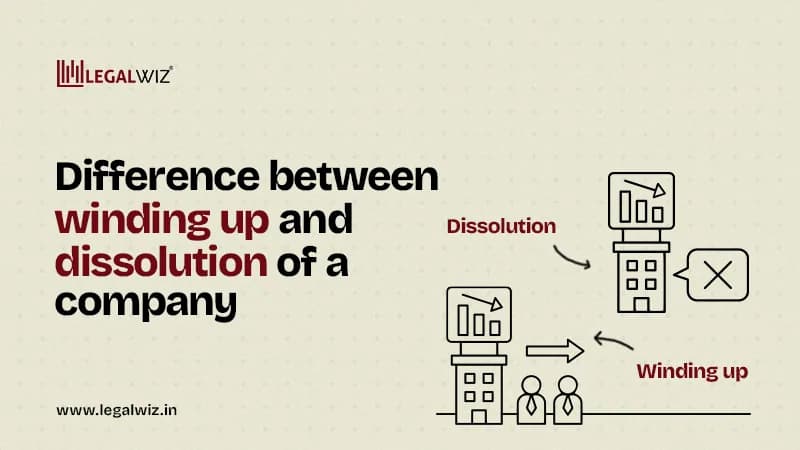
In the corporate world, the terms "winding up" and "dissolution" are often used interchangeably, but they represent distinct legal processes.
4 min read
Stop the annual filings on an LLP that has stopped trading.
Get started