Legal Documents & Contracts
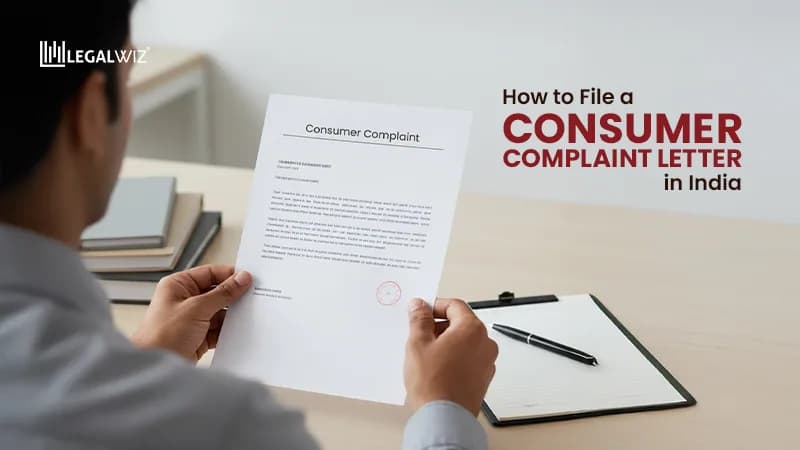
How to File a Consumer Complaint in India
Most people buy something or use a service expecting it to work the way it should. When it fails, it naturally leaves them feeling cheated or annoyed.
4 min read

The written complaint a consumer makes about a product or a service. Sent to the seller first, and the document a Commission will expect to see if it goes further.
A few details, then secure checkout. Your expert takes it from there.
Prefer to talk to someone first?
A written complaint by a consumer who is not satisfied with a product or a service they paid for.
A consumer complaint is a written complaint filed by a consumer who is not satisfied with either the product or the service provided by a company or by the seller of that product. It can be made directly to the company, the producer or the seller, or it can be filed with a Consumer Commission, which resolves it on the facts given by both parties.
It can only be filed by the consumer, and not by anybody else on their behalf. That is the rule that catches people out most often: a friend or a relative who bought the item is the consumer, not the person using it.
The complaint is made on plain paper, addressed to the party being complained about, and signed by the consumer. In practice it is sent to the seller first: a Commission will want to see that the other side was given a chance to put things right, and most matters end there.
This is the complaint letter. Representing you before a Consumer Commission is a separate engagement, so tell us on the call if that is where this is heading.
What was bought, when, what was promised and what happened, in date order. Most complaints fail on being unreadable rather than on being wrong.
The invoice, the warranty card, the order confirmation and any emails. A complaint with no proof of purchase is a complaint by somebody who may not be a consumer.
A refund, a replacement, a repair or compensation: say which, and say how much. "Take necessary action" gives the other side nothing to agree to.

Had a great experience with LegalWiz for my trademark registration. The service was smooth, and the after sales support was excellent. Although the filing took around 3 days, the team stayed connected throughout, provided clear updates, and there were no communication issues. Overall, a very professional and reliable experience.
Had a wonderful experience. The team was very supportive, responsive and completed everything on time. Thank you for the excellent support.
Jignesh was very helpful and amazing while filling the compliance form for my business. Will take your service again.
Good support team. No hindrance in executions. Go for it.
JIGNESH BHAI, I wanted to take some time to sincerely thank you for your incredible support with my MSME registration through LegalWiz. From start to finish, Jignesh Bhai, your guidance, patience, and professionalism made what could have been a stressful and confusing process feel completely smooth and manageable. You took the time to explain every step clearly, answered all my questions patiently, and ensured that nothing was left uncertain. Your attention to detail and dedication truly stood out, and it gave me a lot of confidence throughout the process. I really appreciate the effort, care, and commitment you put into helping me. Jignesh Bhai, your service has been exceptional, and I couldn’t have asked for a better experience. Heartfelt thanks once again!
Highly recommend services from Legalwiz. Got my LLP conversion process faster. Helpful staff.
Limited Liability PartnershipHad a great experience working with the team! They handled my LLP registration smoothly, guided me clearly through every step, and were always quick to respond. Really appreciate their professionalism and support. Highly recommended!
They are so quick and highly professional and experienced in the industry to carry out the requirement. Loved their services.

Trademark RegistrationVery fast & timely service. The team was very helpful and helped me find out if the brand name was available or not over the call itself without any extra cost or charge. Brilliant service, very clear communication, timely delivery & transperant pricing. Cheers!
Trademark RegistrationSatisfied with your unit service and fee grateful to connect with you service providers staff thanks regards Shivlal
File INC-20AI am very much satisfied with their service for INC 20 A. i will recommend them and definitely will keep in mind for any other service.
Close a Private Limited Companyexcellent, i appreciate accountability and transparency in the process
Private Limited CompanyLegalwiz is doing its best to give good service to clients.
Trademark RegistrationRecently got Trade Mark registered
Trademark RegistrationIt was an amazing experience from the support team. Thank you...
GST RegistrationHad a Seamless Experience in registering for GST. Been associated with them for 5 yrs now, and have done several LLP and GST registrations. Happy with their service, so i keep coming back.
Leverage best deals offered by the industry leaders and experience mutual growth.












Still have a question? Our team is happy to help, at no charge and with no obligation to buy anything.
The Consumer Protection Act, 2019, which replaced the 1986 Act and has been in force since July 2020. Complaints are now heard by District, State and National Consumer Disputes Redressal Commissions.
Under the 2019 Act a complaint may be filed where you reside or work, as well as where the opposite party carries on business. Under the old Act it was generally the seller’s location only.
Complaints may also be filed electronically, so an online seller in another state is no longer a reason not to pursue it.
Two years from the date the cause of action arose. A Commission may admit a later complaint if it is satisfied there was sufficient reason for the delay, but that is not something to rely on.
No. A consumer may appear in person before a Commission, which is deliberate, because the Act was written to be usable without one.
A drafted complaint still helps, because it is the document everything after it is built on.
Not as the complainant. The complaint has to be filed by the consumer. A recognised consumer association, or a legal heir where the consumer has died, are the recognised exceptions.
Most people buy something or use a service expecting it to work the way it should. When it fails, it naturally leaves them feeling cheated or annoyed.
4 min read
Retirement might feel like a distant galaxy, but your tax-saving strategy doesn’t have to travel that far!
6 min read

The history of money lending traces back to about 3000 BC in ancient Mesopotamia. Borrowing is a part and parcel of life.
6 min read
The facts in order, the relief stated, and something that stands up if it goes further.
Get started