
GST
How to Download GST Registration Certificate Online
Need to download your GST certificate but not sure where to begin? You’re not alone.
5 min read

Every transaction recorded, reconciled and turned into statements you can act on. Run by accountants rather than by whoever in the office has the time.
A few details, then secure checkout. Your expert takes it from there.
Starting at₹3,000+ Govt. Fees
Prefer to talk to someone first?
Bookkeeping records what happened. Accounting turns the record into statements. You need both, and the law assumes you have them.
Bookkeeping is the recording of a business’s day to day financial affairs. Accounting is the preparation of the financial accounts on top of that record. Every form of business needs both, from a freelancer through to an industrial group, and there are prescribed standards a set of books has to conform to.
The compulsion is only half the reason to do it properly. Nobody can make a decision about an entity without knowing where it stands financially, and a set of books that is six months behind cannot answer that question at all. Up to date records are what let an owner see the position on the day they need it rather than at the year end.
Where the books sit has changed. Traditional accounting software ran on a machine in the office; cloud accounting runs online and is reachable from anywhere, which is what made remote and outsourced arrangements practical. Both work here, and the choice is yours rather than ours.
The reports a set of books has to produce, prepared from your own records.
Stock management is not part of this service. It is a separate piece of work and is quoted separately.
The records live online rather than on one machine in one office, which is what makes a remote arrangement work at all.
Automation takes time out of the process and takes error out of the statements at the same time.
Not just the accountant. Owners and managers see the transactions as they land rather than at the month end.
A crashed laptop stops being an accounting emergency. The data online is unaffected by what happens to the machine.
Every individual, firm and company needs to know what came in and what went out to plan anything at all. Without that split, resource allocation is guesswork dressed up as a decision.
An owner or manager is not present at every transaction. Current records are what let them see the activity of the business from time to time without having to reconstruct it first.
Monthly or quarterly reconciliation is what shows which parts of the business are working and which are not. A decision taken after the profit and loss has been analysed is a different decision.
Nobody invests before analysing the financial position. Approaching an investor with books that are inconsistent or out of date is the fastest way to end the conversation.
Returns, filings and any scrutiny all draw on the same records. Where the books are current, extracting and submitting the data on time is administration rather than a scramble.

I truly appreciate the professionalism and helpful approach of Miss Sachi. Congratulations to the team for having a staff member like her. Thank you
So far good experience. Still need to complete the full compliance before due date by LegalWiz team.
Excellent service and knowledge. There were a few delays in the last month (both due to us not providing info & change of account ownership from LegalWiz side), however the overall quality of each service delivered is top class. We will definitely continue to use and recommend LegalWiz to our friends and family as well.
Appreciate with the prompt service
Ms Kinjal has been very helpful. I look forward to her support. Thank you.
ALL GOOD THANKS :)
Overall Excellent Service
Keep up the good work and customer commitment
The source records. The more complete these are, the less reconstruction there is.
The registration papers of the company, LLP or firm whose books these are.
For the financial year or month by month, with remarks against the entries where you have them.
Every invoice raised and received during the period being written up.
Bills for expenses incurred, including cash expenses that never touched the bank.
Details of what is owed to the business and what the business owes.
Any other government registration the entity holds, since several of them affect how a transaction is recorded.
Bank statements of a partner or member where the account was used for business transactions, with remarks.
Expenses met by the promoters for the registration of the company or LLP, which belong in the first year’s books.
Step 01
Step 02
Step 03
Leverage best deals offered by the industry leaders and experience mutual growth.












Still have a question? Our team is happy to help, at no charge and with no obligation to buy anything.
You can, and plenty of owners do until the volume makes it a bad use of their day.
What an expert changes is the error rate, the time it takes off you, and the fact that a missed transaction is somebody’s job to catch rather than something you discover at the year end.
Yes. Every registered private limited company goes through a statutory audit, and an audit needs books to audit.
A dormant company is a smaller job than a trading one, but it is not a job that can be skipped.
Yes. The team adopts what you already run rather than moving your books, and works in Tally, Zoho Books, QuickBooks and others.
If you have bought a cloud package and not set it up, share the credentials and your relationship manager will take it from there.
No. The process runs online and you can reach the data at any point.
Where the books are kept in Tally rather than on the cloud, you can ask for the data to be extracted and handed over whenever you want it.
Data secrecy is treated as a priority rather than a policy line. Access is controlled and the working process is built around it.
On cloud platforms the security measures are the platform’s own, which for the major systems is a considerably higher standard than a laptop in an office.
The service is upgraded on a pro rata basis. It is a few steps and it does not restart the engagement.
No. Stock management is separate work and is quoted separately.
What is included is the verification of invoices and bills, ledger accounts, trial balance, profit and loss account, balance sheet, bank reconciliation statement, and receivables and payables.
Any time. The best time is the beginning of a financial year, because then the whole year is written up on one basis rather than picked up halfway.
Functionally, very little. Both produce the same records and the same statements.
The difference is where the software runs. Traditional accounting is installed on your own hardware; cloud accounting is reached online, which is what makes it accessible from anywhere and what put a backup outside your office.
All of them. Home based businesses, small and medium enterprises, large industry and freelancers all have to keep their accounts in order.
The argument is the same at every size: a core team focused on the business grows it faster than one splitting its attention with the ledger.
Need to download your GST certificate but not sure where to begin? You’re not alone.
5 min read
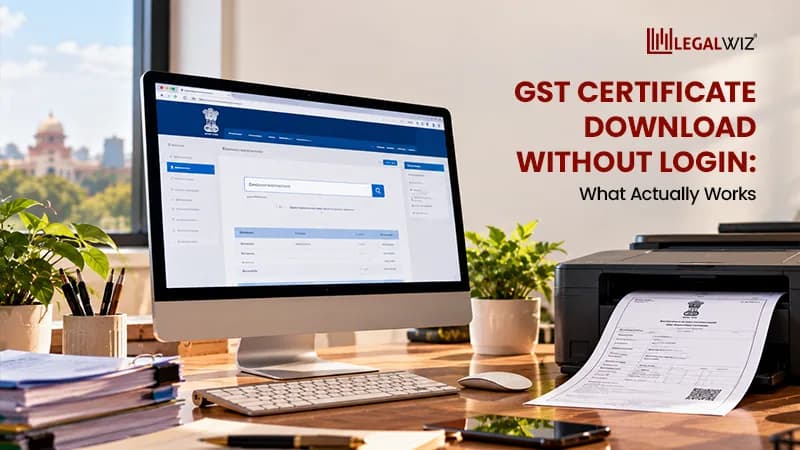
Lost your GST login? Here is the honest answer, and how to get your certificate back anyway
4 min read
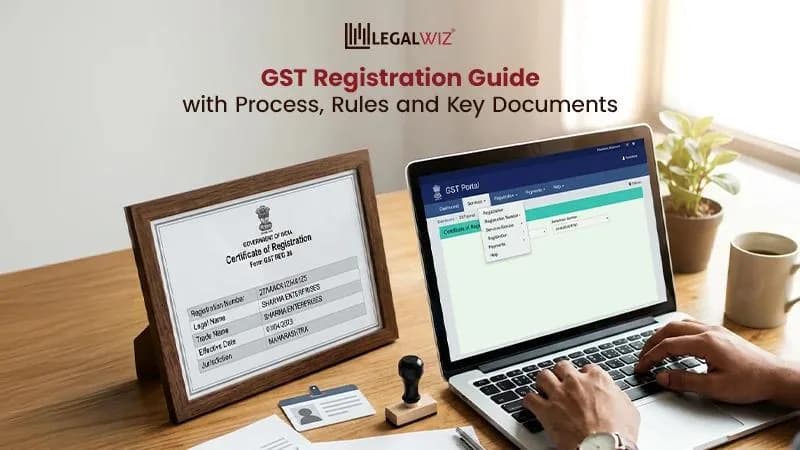
Getting a GST registration is the first step to running a business in India with full compliance.
9 min read
Entries kept current, statements prepared, and one person on your account.
Get started