Legal Documents & Contracts
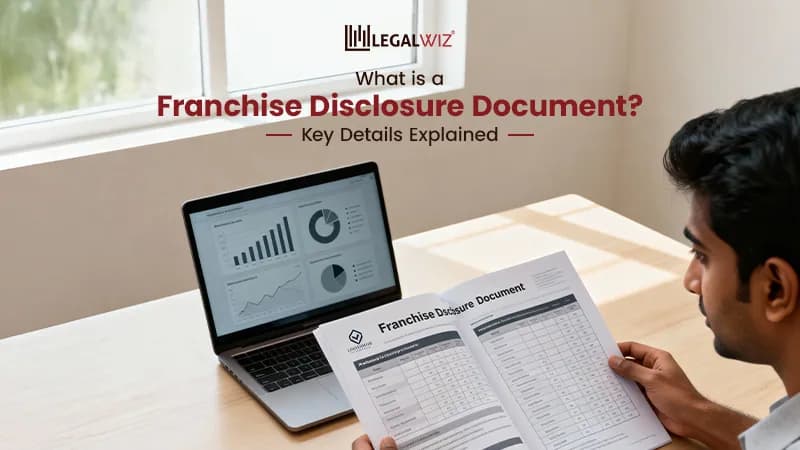
What is a Franchise Disclosure Document? Key Details Explained
Franchising is often seen as an easier way to start a business. But it still comes with serious legal and financial responsibility.
4 min read

The agreement that makes a conversation safe to have. Sign it before you disclose anything. An NDA signed afterwards protects nothing that was already said.
A few details, then secure checkout. Your expert takes it from there.
Prefer to talk to someone first?
A legal agreement that keeps the information you share confidential, and gives you a remedy if it is not.
A non-disclosure agreement, or NDA, is a legal agreement that ensures the confidentiality of the data you share with others. It gives you legal protection, making sure the people who get access to your confidential data do not misuse it. It comes in useful whenever you disclose your business’s confidential and proprietary information, which, as an entrepreneur, you do often.
It works in the other direction too. Other businesses you are working with, or about to work with, may share their confidential information with you and ask you to sign an NDA, so understanding the nuances of one is worth as much when you are the receiving party.
It is the most commonly used legal document in business, because a wide range of confidential information is exchanged between businesses every day. Source code for a software company, customer data for an e-commerce business, information about an invention: all of it should be protected before it is shared, not after.
Tell our experts the purpose behind having the NDA, and they will take care of the rest.
Define it clearly, and define it broadly, so that it covers almost everything you are likely to share. A narrow definition protects only the examples somebody thought of on the day.
Not everything shared is confidential, and saying so protects the rest. Anything already public, anything the other side already knew, anything a third party is free to disclose, and anything they developed independently.
When the information may be shared onward, and to whom: advisers, employees, a regulator. An NDA with no route for a legitimate disclosure gets broken rather than followed.
How long the obligations last, which law governs the agreement, and which courts decide a dispute. The last two matter most where the parties are in different countries.
Four situations where information leaves your control, and only one of them is a hire.
During discussions with investors at the time of raising funds, when you are describing the business in more detail than you would to anyone else.
When you share confidential information with a third party while exploring a business partnership, before there is any other contract between you.
When you share confidential and proprietary data with your own staff or with a freelancer working on your systems.
Disclosure made while taking professional consultancy. Advisers are usually under their own duty of confidence, and an NDA makes the scope of it explicit.
One with your own staff and one with everybody else. They are signed at different moments and only one of them has a problem with what the signer gets in return.
| Attribute | NDA with an employee | NDA with a third party |
|---|---|---|
| When you need which | ||
| Your own staffAnyone on the payroll who will see trade secrets, customer data, financial information or technical know-how in the course of their work. | Anyone outsideA prospective investor, a collaborator, an outsourced developer, a freelancer, a consultant or a professional adviser. | |
| At the startAt the beginning of the employment, alongside the rest of the joining paperwork. Signing one later is possible but changes what has to be given in return, as the row below sets out. | Before you talkBefore the first substantive conversation. An NDA signed after the information has been shared protects nothing that was said before it. | |
| One wayThe employer discloses and the employee receives. There is rarely anything flowing back that needs protecting. | Often both waysTwo businesses exploring a partnership usually each have something to protect, so the obligations are written to bind both sides equally. | |
| Getting it right | ||
| Yes, if it is laterAn NDA signed at the start is supported by the job itself. Put one in front of somebody already employed and they should be offered a benefit over and above their existing salary, or there is nothing they received for agreeing to it. | The deal itselfThe exchange of confidential information, and the discussions it is for, is what each side receives. Nothing separate is needed. | |
| YesThe same obligations are often written into the employment contract as a confidentiality clause instead of a separate agreement. A standalone NDA is clearer and easier to point at. | SometimesA confidentiality clause inside a service agreement or a contractor agreement covers the same ground once the deal is signed. A separate NDA is what covers the period before it, when there is no other contract yet. | |
| Not mandatoryIt may be drafted on plain paper or on stamp paper, whichever the employer prefers. | Not mandatoryAdvisable rather than required, and it needs no notary. Stamping is about proving the document existed on the date it says it did. | |
| Next step | Know more | Know more |
Swipe the table sideways. Open any attribute to read the detail behind both answers.

Had a great experience with LegalWiz for my trademark registration. The service was smooth, and the after sales support was excellent. Although the filing took around 3 days, the team stayed connected throughout, provided clear updates, and there were no communication issues. Overall, a very professional and reliable experience.
Had a wonderful experience. The team was very supportive, responsive and completed everything on time. Thank you for the excellent support.
Jignesh was very helpful and amazing while filling the compliance form for my business. Will take your service again.
Good support team. No hindrance in executions. Go for it.
JIGNESH BHAI, I wanted to take some time to sincerely thank you for your incredible support with my MSME registration through LegalWiz. From start to finish, Jignesh Bhai, your guidance, patience, and professionalism made what could have been a stressful and confusing process feel completely smooth and manageable. You took the time to explain every step clearly, answered all my questions patiently, and ensured that nothing was left uncertain. Your attention to detail and dedication truly stood out, and it gave me a lot of confidence throughout the process. I really appreciate the effort, care, and commitment you put into helping me. Jignesh Bhai, your service has been exceptional, and I couldn’t have asked for a better experience. Heartfelt thanks once again!
Highly recommend services from Legalwiz. Got my LLP conversion process faster. Helpful staff.
Limited Liability PartnershipHad a great experience working with the team! They handled my LLP registration smoothly, guided me clearly through every step, and were always quick to respond. Really appreciate their professionalism and support. Highly recommended!
They are so quick and highly professional and experienced in the industry to carry out the requirement. Loved their services.

Trademark RegistrationVery fast & timely service. The team was very helpful and helped me find out if the brand name was available or not over the call itself without any extra cost or charge. Brilliant service, very clear communication, timely delivery & transperant pricing. Cheers!
Trademark RegistrationSatisfied with your unit service and fee grateful to connect with you service providers staff thanks regards Shivlal
File INC-20AI am very much satisfied with their service for INC 20 A. i will recommend them and definitely will keep in mind for any other service.
Close a Private Limited Companyexcellent, i appreciate accountability and transparency in the process
Private Limited CompanyLegalwiz is doing its best to give good service to clients.
Trademark RegistrationRecently got Trade Mark registered
Trademark RegistrationIt was an amazing experience from the support team. Thank you...
GST RegistrationHad a Seamless Experience in registering for GST. Been associated with them for 5 yrs now, and have done several LLP and GST registrations. Happy with their service, so i keep coming back.
Leverage best deals offered by the industry leaders and experience mutual growth.






Still have a question? Our team is happy to help, at no charge and with no obligation to buy anything.
It protects the confidential information you are sharing with third parties. It creates the trust that your information will not be spilled out without your consent, and it ensures you have a legal remedy in the event that it is.
Parties capable of entering into a contract under the Indian Contract Act, 1872 can sign an NDA.
With as many parties and as many times as you like. Each time you enter into one with a different party you may have to make minor changes to the names of the parties and to the categories of confidential information.
All the details you consider confidential and proprietary to your business, which if disclosed to third parties without your knowledge are likely to cause losses to you or to the business.
What cannot be covered is information already in the public domain, information the other party already knew, facts disclosed by a third party entitled to disclose them, and anything the other party developed independently.
Yes. It is a legally binding document and the parties can file a suit in the event of a breach of any of its terms.
It is not mandatory but it is advisable to use stamp paper, which helps establish the validity and the existence of the document. An NDA does not require a notary.
Franchising is often seen as an easier way to start a business. But it still comes with serious legal and financial responsibility.
4 min read
In today’s rapidly evolving business environment, companies face numerous challenges in managing their workforce.
6 min read

With the introduction of artificial intelligence and metaverse, innovation knows no bounds.
5 min read