Intellectual Properties
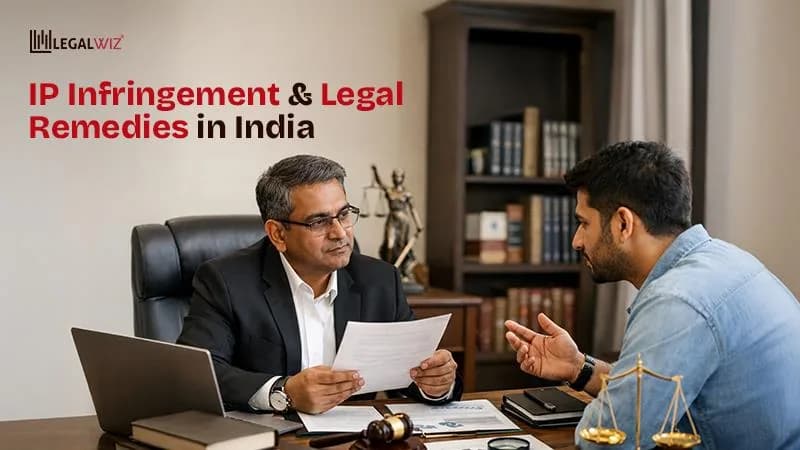
IP Infringement and Legal Remedies in India
Intellectual property is more than a legal concept. It is business asset that carries real value.
5 min read

Copyright exists the moment you create something. Registering it is what puts your ownership on the public record and gives you the standing to act when somebody copies your work.
A few details, then secure checkout. Your expert takes it from there.
Starting at₹4,098+ Govt. Fees
Prefer to talk to someone first?
What copyright gives you automatically, what registration adds, and why creators choose LegalWiz.in to file it.
Copyright gives the original creators of literature, art, music, sound recordings, films and broadcasts the monetary rights in their work. It is what lets a creator earn from a creation, by making copies, performing it in public, broadcasting it, issuing copies, and licensing it for the many uses that exist online.
Copyright is created automatically, at the moment the creator makes something. Nothing needs to be filed for it to exist.
Registration is what makes it usable. It creates a definite public record of ownership, it stands as prima facie evidence if a dispute reaches court, and, the reason most people file, it is what gives the holder the standing to bring an infringement case at all.
Everything below is handled by your relationship manager and the filing team. You supply the details of the work once.
Government fees are charged at actuals and are levied per work: ₹500 for a literary, dramatic, musical or artistic work, and ₹2,000 where a sound recording, film or artistic work is used in relation to goods under section 45.
An original creation that exists as something: a book, a DVD, a painting. An idea on its own cannot be copyrighted.
Books, computer programs, compilations of any kind, and online writing such as a blog or a series of articles.
Music and sound recordings, including lyrics, and cinematograph films.
Paintings, sculptures, graphics, maps and architectural plans.
Registration provides prima facie evidence if litigation arises. Proof is what a court needs before anything can be established, which is what makes registration so useful to a creator in a dispute.
Registering a copyright creates a definite public record, which is what lets the original creator establish ownership of the work against anybody who claims it.
A person cannot bring a copyright infringement case without a registered copyright. Registration is what gives the holder the official right to file for infringement and to claim damages.
Copyright protection is not limited to the creator’s lifetime, and it runs longer than any other intellectual property right: the creator’s life, and 60 years after their death.
Copyright protects the work. It does not protect the brand name it is sold under, or an invention behind it, and those need a different right.
| Attribute | Copyright | Trademark | Provisional Patent | Permanent Patent |
|---|---|---|---|---|
| What it covers | ||||
| Artistic worksAll types of original artistic, dramatic or musical work | Brand name and logoA logo, a design, packaging material, or the name of a business or company | InventionsA new invention idea, with a prototype | InventionsA new invention idea, with a prototype | |
| Governing Act | The Copyright Act, 1957 | Trade Marks Act, 1999 | The Patents Act, 1970 | The Patents Act, 1970 |
| How you get it | ||||
| OptionalCopyright arises on creation, but registration is what lets you sue | MandatoryRequired to claim an exclusive right over the mark | MandatoryThere is no unregistered equivalent | MandatoryThere is no unregistered equivalent | |
| NoDoes not require any provisional application | NoDoes not require any provisional application | NoIt is the provisional application itself | OptionalA complete specification can be filed directly, or within 12 months of a provisional application | |
| What it gives you | ||||
| Yes© | Yes™ once the application is filed, ® once registered | NoThere is no symbol for a patent | NoThere is no symbol for a patent | |
| Lifetime, plus 60 yearsThe creator’s lifetime, and 60 years after their death | 10 yearsRenewable every 10 years, with no limit on the number of renewals | 12 monthsThe complete specification must be filed inside that year, or it lapses | 20 yearsFrom the date of application, including the year of the provisional filing | |
| Next step | Get started | Know more | Know more | Know more |
Swipe the table sideways, Copyright stays in view. Open any attribute to read the detail behind all 4 answers.

Had a great experience with LegalWiz for my trademark registration. The service was smooth, and the after sales support was excellent. Although the filing took around 3 days, the team stayed connected throughout, provided clear updates, and there were no communication issues. Overall, a very professional and reliable experience.
Had a wonderful experience. The team was very supportive, responsive and completed everything on time. Thank you for the excellent support.
Jignesh was very helpful and amazing while filling the compliance form for my business. Will take your service again.
Good support team. No hindrance in executions. Go for it.
JIGNESH BHAI, I wanted to take some time to sincerely thank you for your incredible support with my MSME registration through LegalWiz. From start to finish, Jignesh Bhai, your guidance, patience, and professionalism made what could have been a stressful and confusing process feel completely smooth and manageable. You took the time to explain every step clearly, answered all my questions patiently, and ensured that nothing was left uncertain. Your attention to detail and dedication truly stood out, and it gave me a lot of confidence throughout the process. I really appreciate the effort, care, and commitment you put into helping me. Jignesh Bhai, your service has been exceptional, and I couldn’t have asked for a better experience. Heartfelt thanks once again!
Highly recommend services from Legalwiz. Got my LLP conversion process faster. Helpful staff.
Limited Liability PartnershipHad a great experience working with the team! They handled my LLP registration smoothly, guided me clearly through every step, and were always quick to respond. Really appreciate their professionalism and support. Highly recommended!
They are so quick and highly professional and experienced in the industry to carry out the requirement. Loved their services.

Trademark RegistrationVery fast & timely service. The team was very helpful and helped me find out if the brand name was available or not over the call itself without any extra cost or charge. Brilliant service, very clear communication, timely delivery & transperant pricing. Cheers!
Trademark RegistrationSatisfied with your unit service and fee grateful to connect with you service providers staff thanks regards Shivlal
File INC-20AI am very much satisfied with their service for INC 20 A. i will recommend them and definitely will keep in mind for any other service.
Close a Private Limited Companyexcellent, i appreciate accountability and transparency in the process
Private Limited CompanyLegalwiz is doing its best to give good service to clients.
Trademark RegistrationRecently got Trade Mark registered
Trademark RegistrationIt was an amazing experience from the support team. Thank you...
GST RegistrationHad a Seamless Experience in registering for GST. Been associated with them for 5 yrs now, and have done several LLP and GST registrations. Happy with their service, so i keep coming back.
Four things, and none of them is the work itself in every case, because for online work, a URL will often do.
Name, address and nationality. A body corporate also provides its certificate of registration.
The applicant’s interest in the copyright: whether they are the original creator or a representative of one.
The type and description of the work, its title or URL, and the language it is in.
The date the creative work was first published.
Step 01
Step 02
Step 03
Subject to government processing time.
Ten to twelve working days from your brief to a filed application.
2 of 12 working days
3 of 12 working days
7 of 12 working days
Subject to government processing time.
Leverage best deals offered by the industry leaders and experience mutual growth.






Still have a question? Our team is happy to help, at no charge and with no obligation to buy anything.
Anything that is not fixed in a tangible form. Ideas, procedures, methods, systems, processes, concepts, principles, discoveries and unwritten speeches cannot be copyrighted.
The work has to exist as something before it can be protected.
Any original creation that exists in a tangible form, including:
The owner has the exclusive right to:
Sixty years, but the point it is counted from depends on the work. For literary, dramatic, musical and artistic works, the 60 years run from the year following the death of the author.
For cinematograph films, sound recordings and photographs the 60 years are counted from the date of publication. For a broadcast the term is 25 years, from the beginning of the calendar year following the year it was first broadcast.
Yes. You can send a legal notice to the person concerned.
If the infringement continues after that, you can assert your exclusive right in court and claim damages.
Yes. An original creator may sell, transfer, assign or license their copyright.
You can register original authorship on a website, but a domain name cannot be protected under copyright law.
Each element counts as a separate work, photographs and videos included, so a separate application fee is payable for each of them.
A trademark protects a brand name, a logo or a slogan. Copyright protects unique content: a book, music, video, song or other artistic work.
In practice a website owner usually protects the content rather than the supporting works, because photographs and videos uploaded to a site tend to change as the business does.
The employer. Where a program is made in the course of the author’s employment under a contract of service or apprenticeship, the employer is the first owner of the copyright.
That is the default position, and it applies in the absence of any agreement to the contrary.
No. There is no mechanism to search for already-existing works on the copyright registry website.
That is one of the ways copyright differs from a trademark, where a search before filing is both possible and advisable.
Both copyright law and design law apply to jewellery.
It is generally preferable to take copyright protection on the design sketches, as artwork, because copyright runs for considerably longer than the protection design law provides.
They are charged per work. A literary, dramatic, musical or artistic work is ₹500 per work.
Where a sound recording, cinematograph film, or a literary or artistic work is used, or is capable of being used, in relation to goods under section 45, the fee is ₹2,000 per work.
Intellectual property is more than a legal concept. It is business asset that carries real value.
5 min read
Patent registration is not just about having a new idea.
5 min read
Legal protection does not move on its own. For founders, creators, and businesses, the first question is rarely legal theory.
4 min read
Put your ownership on the record, before you need to prove it.
Get started