Business Registrations
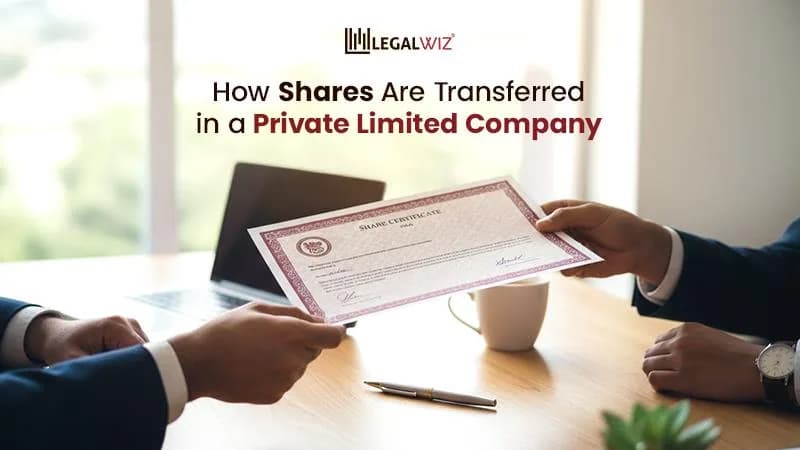
How Shares Are Transferred in a Private Limited Company
A share transfer in a private limited company involves more than a simple exchange of ownership.
7 min read

A company can issue shares only up to the authorised capital in its Memorandum. Raise that ceiling first, and the paid-up capital can follow.
A few details, then secure checkout. Your expert takes it from there.
Starting at₹5,499+ Govt. Fees
 4.7/5 Ratings On Google
Prefer to talk to someone first?
What authorised capital is, why it has to be raised before anything else can be, and why companies choose LegalWiz.in.
Share capital is the part of a company’s capital that is raised by issuing shares. A company may raise capital only up to the authorised capital stated in its Memorandum, and that ceiling can be increased at any time after incorporation on payment of an additional fee and stamp duty.
Because a company can issue shares only up to its authorised capital, that figure determines how many shares it can issue. It is set in the capital clause of the MoA. So to increase the capital-raising capacity, the authorised capital has to go up first. A company that wants to increase its paid-up capital cannot do so until it has room in the ceiling above it.
Altering the authorised capital clause means holding a meeting of the board and a meeting of the members for their respective consents, which is then followed by an application to the MCA.
Your relationship manager and the filing team handle everything below. You supply the documents once and approve the drafts.
Government fees and stamp duty are charged at actuals, and both scale with the authorised capital. The transfer of shares is not included in this package.
The maximum amount of capital a company may raise. This is the figure this service increases.
The part of the authorised capital that has been issued in order to raise capital.
The part of the issued capital that the shareholders have subscribed to pay.
The part of the capital that has been subscribed and actually paid to the company by the shareholders.
Two reasons, and both are consequences of the same ceiling.
A company cannot raise capital beyond the amount prescribed in its Memorandum. So where the need arises to increase the paid-up capital, the authorised capital has to be increased first, and there is no way round it.
An increase in internal funding capacity supports the company’s ability to borrow. The higher the capital, the higher the net worth, and the higher the borrowing capacity that follows from it.
Had a great experience with LegalWiz for my trademark registration. The service was smooth, and the after sales support was excellent. Although the filing took around 3 days, the team stayed connected throughout, provided clear updates, and there were no communication issues. Overall, a very professional and reliable experience.
Had a wonderful experience. The team was very supportive, responsive and completed everything on time. Thank you for the excellent support.
Jignesh was very helpful and amazing while filling the compliance form for my business. Will take your service again.
Good support team. No hindrance in executions. Go for it.
JIGNESH BHAI, I wanted to take some time to sincerely thank you for your incredible support with my MSME registration through LegalWiz. From start to finish, Jignesh Bhai, your guidance, patience, and professionalism made what could have been a stressful and confusing process feel completely smooth and manageable. You took the time to explain every step clearly, answered all my questions patiently, and ensured that nothing was left uncertain. Your attention to detail and dedication truly stood out, and it gave me a lot of confidence throughout the process. I really appreciate the effort, care, and commitment you put into helping me. Jignesh Bhai, your service has been exceptional, and I couldn’t have asked for a better experience. Heartfelt thanks once again!
Highly recommend services from Legalwiz. Got my LLP conversion process faster. Helpful staff.
Limited Liability PartnershipHad a great experience working with the team! They handled my LLP registration smoothly, guided me clearly through every step, and were always quick to respond. Really appreciate their professionalism and support. Highly recommended!
They are so quick and highly professional and experienced in the industry to carry out the requirement. Loved their services.

Trademark RegistrationVery fast & timely service. The team was very helpful and helped me find out if the brand name was available or not over the call itself without any extra cost or charge. Brilliant service, very clear communication, timely delivery & transperant pricing. Cheers!
Trademark RegistrationSatisfied with your unit service and fee grateful to connect with you service providers staff thanks regards Shivlal
File INC-20AI am very much satisfied with their service for INC 20 A. i will recommend them and definitely will keep in mind for any other service.
Close a Private Limited Companyexcellent, i appreciate accountability and transparency in the process
Private Limited CompanyLegalwiz is doing its best to give good service to clients.
Trademark RegistrationRecently got Trade Mark registered
Trademark RegistrationIt was an amazing experience from the support team. Thank you...
GST RegistrationHad a Seamless Experience in registering for GST. Been associated with them for 5 yrs now, and have done several LLP and GST registrations. Happy with their service, so i keep coming back.
A short checklist. Everything else is drafted for you.
The DSC of one of the authorised directors of the company.
A copy of the latest amended Memorandum and Articles of Association.
The Certificate of Incorporation of the company.
A copy of the PAN card of the company.
Step 01
Step 02
Step 03
Subject to government processing time.
Ten working days end to end. The resolutions and the filing take six; the rest is the Registrar’s.
1 of 10 working days
3 of 10 working days
2 of 10 working days
4 of 10 working days
Subject to government processing time.
Leverage best deals offered by the industry leaders and experience mutual growth.








Still have a question? Our team is happy to help, at no charge and with no obligation to buy anything.
The increase has to receive three consents or approvals:
Within 30 days of obtaining the consent of the shareholders for the increase in share capital.
The resolution passed is notified in MGT-14, and the notice of increase is filed in SH-7 with the altered MoA and AoA.
Yes. The total authorised and paid-up capital is displayed on the master data of the company on the MCA portal.
Yes. The government fee for any e-form filed with the MCA depends on the authorised capital of the company.
So an increase in authorised capital does raise the fee for future online filings, though only to a nominal extent.
Yes, the package cost includes the increase in the paid-up capital of the company.
It does not include the transfer of shares.
A share transfer in a private limited company involves more than a simple exchange of ownership.
7 min read
Private limited companies are the backbone of India’s startup and growth ecosystem. Founders prefer this structure because control remains concentrated and personal liability stays limited.
8 min read
To save you the trouble, here is a guide that walks you through the usual errors and how to stay clear of them.
5 min read
Lift the ceiling before you need the room under it.
Get started