Business Registrations
How to Reopen or Restore a Struck-Off Private Limited Company in India
Imagine you registered a private limited company a few years ago, but it was stricken off the records due to paperwork or commercial slowdown.
6 min read

When the purpose is met, or the partners decide to end it, the firm has to be wound up properly: assets sold, liabilities paid, and every partner’s claim discharged. That is what a dissolution deed settles.
A few details, then secure checkout. Your expert takes it from there.
Starting at₹4,299+ Govt. Fees
Prefer to talk to someone first?
What dissolution actually involves, the two ways it happens, and why firms choose LegalWiz.in to draft the deed.
A partnership firm is a business entity formed with the sole purpose of profit from business: two or more parties come together under a formal agreement, the partnership deed, to own and manage it. Once that purpose is met, or the partners decide to put an end to the partnership, it has to be dissolved and the partnership comes to an end.
On dissolution the business of the firm ceases to exist, because its affairs are wound up: the assets are sold, the liabilities are paid, and the claims of the partners are discharged. The dissolution of the partnership among all the partners of a firm is what is called the dissolution of the firm, and it is usually done through a dissolution agreement between the partners.
That is worth distinguishing from the dissolution of a partnership, which is what happens when a single partner ceases to be associated with the business. The dissolution of the firm is the winding up of the business itself.
Your relationship manager and the drafting team handle everything below. You supply the documents once and execute the deed.
Stamp duty and notary charges are at actuals. A partnership firm is not registered with the MCA, so unlike a company or an LLP there is no strike-off application and no government processing period to wait on. The dissolution is complete when the deed is.
The date on which the partnership ceases trading and is dissolved, and how it will be wound up. What the partners may and may not do between those two dates.
The return of documents, the realisation of the partnership’s assets, the termination of contracts and the other arrangements for discharging its liabilities.
The preparation and approval of the partnership’s final set of accounts, and the distribution of any money left after the liabilities have been discharged.
The retention of the firm’s records, and the notification of the dissolution, which is what ends a partner’s liability to third parties.
Almost every dissolution is the second. The first is what happens when the partners cannot agree.
Usually partnership firms are dissolved through a dissolution agreement between the partners. All the partners come together and sign an agreement confirming the dissolution and mutually settling every pending liability and account between them, so no third party is involved. It can also be dissolved by a written notice of dissolution sent by one partner to all the others.
Where a dissolution is initiated by one partner suing the others, the courts get involved. A court can only dissolve a firm that is registered with the Registrar of Firms: an unregistered firm cannot be dissolved by a court at all.
Almost every dissolution is by agreement. Open any row to read the detail behind both answers.
| Attribute | By agreement | Through a court |
|---|---|---|
| Which route applies | ||
| The partners agreeAll the partners come together and sign an agreement confirming the dissolution. It can also start with a written notice of dissolution sent by one partner to all the others. | A partner suesThe courts get involved when a dissolution is initiated by one partner suing the others. | |
| Any firmRegistered or not, the dissolution is a matter between the partners. | Registered firms onlyA court can dissolve a firm only where it is registered with the Registrar of Firms. An unregistered partnership firm cannot be dissolved by a court. | |
| The venture has endedThe term of the partnership has expired, the task it was created for is finished, a partner has become insolvent, a partner has died or resigned, or unlawful business has been carried on in the firm’s name by one of the partners. | Conduct or incapacityA partner has become incapable of carrying out their duties through incapacity or unsoundness of mind, is guilty of misconduct that can harm the business, or has repeatedly breached the partnership agreement. | |
| What it involves | ||
| NoneThe partners mutually settle all the pending liabilities and accounts between themselves, so no third-party intervention is needed. | The courtThe court intervenes and helps the partnership to be dissolved legally. | |
| A dissolution deedIt sets the date the partnership ceases trading, how it is wound up, what the partners may do in between, the realisation of assets, the discharge of liabilities, the final accounts, the distribution of what is left, the retention of records and the notification of the dissolution. | A court orderThe winding up that follows covers the same ground, settling liabilities, realising assets and distributing the surplus, under the court’s direction. | |
| Next step | Get started | |
Swipe the table sideways, By agreement stays in view. Open any attribute to read the detail behind both answers.

Had a great experience with LegalWiz for my trademark registration. The service was smooth, and the after sales support was excellent. Although the filing took around 3 days, the team stayed connected throughout, provided clear updates, and there were no communication issues. Overall, a very professional and reliable experience.
Had a wonderful experience. The team was very supportive, responsive and completed everything on time. Thank you for the excellent support.
Jignesh was very helpful and amazing while filling the compliance form for my business. Will take your service again.
Good support team. No hindrance in executions. Go for it.
JIGNESH BHAI, I wanted to take some time to sincerely thank you for your incredible support with my MSME registration through LegalWiz. From start to finish, Jignesh Bhai, your guidance, patience, and professionalism made what could have been a stressful and confusing process feel completely smooth and manageable. You took the time to explain every step clearly, answered all my questions patiently, and ensured that nothing was left uncertain. Your attention to detail and dedication truly stood out, and it gave me a lot of confidence throughout the process. I really appreciate the effort, care, and commitment you put into helping me. Jignesh Bhai, your service has been exceptional, and I couldn’t have asked for a better experience. Heartfelt thanks once again!
Highly recommend services from Legalwiz. Got my LLP conversion process faster. Helpful staff.
Limited Liability PartnershipHad a great experience working with the team! They handled my LLP registration smoothly, guided me clearly through every step, and were always quick to respond. Really appreciate their professionalism and support. Highly recommended!
They are so quick and highly professional and experienced in the industry to carry out the requirement. Loved their services.

Trademark RegistrationVery fast & timely service. The team was very helpful and helped me find out if the brand name was available or not over the call itself without any extra cost or charge. Brilliant service, very clear communication, timely delivery & transperant pricing. Cheers!
Trademark RegistrationSatisfied with your unit service and fee grateful to connect with you service providers staff thanks regards Shivlal
File INC-20AI am very much satisfied with their service for INC 20 A. i will recommend them and definitely will keep in mind for any other service.
Close a Private Limited Companyexcellent, i appreciate accountability and transparency in the process
Private Limited CompanyLegalwiz is doing its best to give good service to clients.
Trademark RegistrationRecently got Trade Mark registered
Trademark RegistrationIt was an amazing experience from the support team. Thank you...
GST RegistrationHad a Seamless Experience in registering for GST. Been associated with them for 5 yrs now, and have done several LLP and GST registrations. Happy with their service, so i keep coming back.
Most of this is about the firm’s books and its obligations. Everything else is drafted for you.
The PAN of every partner and of the firm, as identity proof.
The original partnership deed and every modified version of it.
Where the registered office is rented, the rent agreement and one utility bill for electricity, water, property tax or gas, together with a no objection certificate from the landlord.
The financial statement of the partnership firm.
A statement of any pending litigation involving the partnership firm.
A list of the secured creditors of the firm, where it has any.
Step 01
Step 02
Step 03
Twenty working days. There is no MCA filing to wait on, so the schedule ends when the deed is executed.
2 of 20 working days
6 of 20 working days
12 of 20 working days
Where the firm is registered with the Registrar of Firms, the dissolution is notified there after the deed is executed.
Leverage best deals offered by the industry leaders and experience mutual growth.












Still have a question? Our team is happy to help, at no charge and with no obligation to buy anything.
The dissolution date is the date the partnership ceases to exist. After it there is no business relationship between the partners.
The partners then complete any unfinished work, settle the liabilities, realise the partnership assets and otherwise wind the partnership up. The winding up date is the date on which that is completed.
Seven things:
The losses of the firm are paid out first. The assets of the firm, and the capital contributed by the partners to set off those losses, are then applied in order.
Third party debts are paid first. Next, any loan taken by the firm from a partner is repaid to that partner. The capital contributed by each partner is then repaid in the capital contribution ratio, and the balance is shared among the partners in their profit-sharing ratios. On realisation all the assets are sold in the market and the cash raised is used to pay the liabilities. Assets or liabilities may also be taken over by a partner, in which case that partner’s capital account is adjusted by the amount.
Three of the commonest are:
The partners remain liable to third parties for any act done before the dissolution.
A partner’s liability ends once every event taken up before the dissolution of the firm is finished, and until public notice of the dissolution is given.
Every partner is entitled to equal rights, or to rights according to the contract between them.
All the partners are entitled to have the property of the firm applied in payment of its debts and liabilities, and to have the surplus distributed among them or their representatives according to their rights. Those rights arise when the firm is being wound up.
Dissolution of a partnership occurs when a partner ceases to be associated with the business.
Dissolution of a firm is the winding up of the business itself.
Imagine you registered a private limited company a few years ago, but it was stricken off the records due to paperwork or commercial slowdown.
6 min read
After finishing company registration online, you get the active company status. But after that there are many different statues that a company goes through.
4 min read
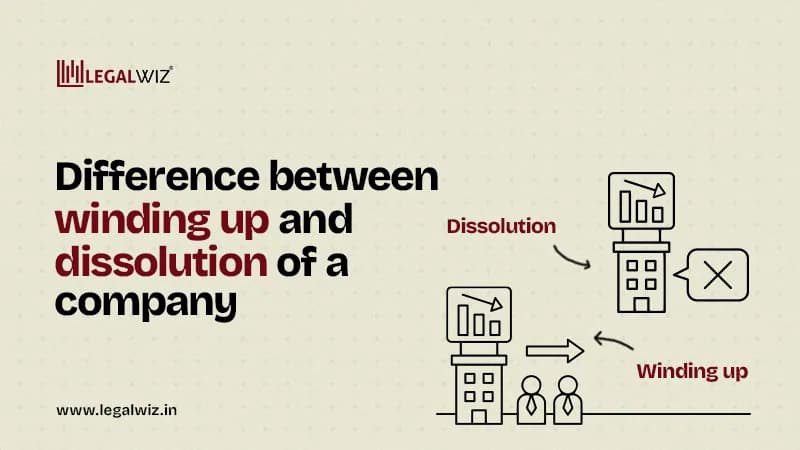
In the corporate world, the terms "winding up" and "dissolution" are often used interchangeably, but they represent distinct legal processes.
4 min read
End the partnership properly, with the accounts settled and the notice given.
Get started