
Compliance
EPF Registration for Employers: Applicability, Rules, and Process
EPF registration is not optional once your workforce crosses the legal employee threshold.
7 min read

The registration that identifies your business as a micro, small or medium enterprise. Voluntary, permanent, free of government fee, and the key to a set of benefits nothing else gives you.
A few details, then secure checkout. Your expert takes it from there.
Starting at₹2,299+ Govt. Fees
Prefer to talk to someone first?
What the registration does, who qualifies, and why it is worth taking even though nothing requires it.
Udyam registration gives a micro, small or medium business a legal and operational identity with the Government of India. It was known as MSME registration and before that as Udyog Aadhaar, and it is governed by the Micro, Small and Medium Enterprises Development Act, 2006. The process moved to Udyam in 2020 to simplify it.
The whole registration is online and based on self-declaration, and it draws the turnover and investment figures from the PAN and GST records already filed against the business, so the classification keeps itself current rather than being re-declared each year.
Nothing obliges a business to register. What it is taken for is what it unlocks: collateral-free lending at subsidised rates, a statutory protection against buyers who pay late, rebates on trademark and patent fees, and preference in government tenders.
Getting the class right matters more than the filing does, so that is where we start.
There is no government fee for Udyam registration. Businesses dealing solely in a few excluded activities cannot apply, as the FAQs below explain.
Investment in plant and machinery up to ₹2.5 crore, and annual turnover up to ₹10 crore.
Investment up to ₹25 crore, and annual turnover up to ₹100 crore.
Investment up to ₹125 crore, and annual turnover up to ₹500 crore.
An enterprise is classified by whichever of the two puts it in the higher class, and the figures come from the ITR and GST data filed against its PAN.
Small and medium businesses have always struggled to borrow against no security. A registered enterprise can take collateral-free loans from banks and financial institutions, and at a subsidised rate of interest.
Government fees on a trademark application are higher for a company, an LLP or a partnership than for an individual. Producing the Udyam certificate brings a 50% rebate, and a rebate is prescribed on patent filings too.
Registered businesses get smoother treatment on other licences and with financial agencies, an edge in government tender work, and subsidised or free rates on certifications. ISO certification is free of cost for a Udyam registered business.
Registered businesses are granted concessions on electricity, water and gas, which matters most to anyone manufacturing. Some states add a further rebate on the electricity bill.
Udyam is the only one of these five that nobody makes you take. It is worth knowing what the other four oblige you to do before you decide the order to deal with them in.
| Attribute | MSME / Udyam | GST Registration | Importer Exporter Code | Professional Tax | Shop & Establishment |
|---|---|---|---|---|---|
| Do you have to register | |||||
| Micro, small and medium enterprisesAny enterprise within the investment and turnover limits for its class. Wholesale and retail traders were brought back in from 2021 and are eligible. | Suppliers over the thresholdAny business supplying goods with an aggregate turnover over ₹40 lakh, or services over ₹20 lakh. In the special category states those figures are ₹20 lakh and ₹10 lakh. Several categories have to register whatever their turnover. | Importers and exportersAny business importing into or exporting out of India for commercial purposes. Import or export for personal use, and consignments moved by a government department or a notified charity, are outside it. | Employers and professionalsAnyone earning from a salary, a trade or a profession in a state that levies the tax. An employer registers to deduct it from salaries; a professional or a business owner registers to pay their own. | Every commercial premisesShops, offices, hotels, restaurants, cafes, warehouses and places of public amusement. It attaches to the premises, not to a headcount, so a business with no employees still needs it. Factories are outside it, because they are covered by the Factories Act, 1948. | |
| VoluntaryNothing requires an enterprise to register. It is taken for what it unlocks: collateral-free lending, the protection against delayed payments, and the fee rebates. | Mandatory over the thresholdCompulsory once you cross the turnover limit or fall into a specified category. Below it, registration is voluntary, and many suppliers take it anyway to be able to pass on input tax credit. | Mandatory to tradeThere is no penalty for not holding an IEC. There is simply no import or export without one, and no way to clear a shipment. | Mandatory where leviedCompulsory in the states that have enacted it, and not applicable at all in the states that have not. An employer generally has to register within 30 days of taking on staff. | MandatoryCompulsory in most states within 30 days of the business being set up, and each branch registers separately whatever the jurisdiction. | |
| Who runs it | |||||
| Ministry of MSMECentral, through the Udyam Registration portal. The registration draws turnover and investment figures from your PAN and GST records rather than from a declaration. | Central and stateAdministered jointly. On a sale within a state the tax splits into CGST for the centre and SGST, or UGST in a union territory, for the state. On a sale between states, IGST is levied instead. | DGFTThe Directorate General of Foreign Trade, under the Ministry of Commerce and Industry. One code per PAN, valid for every branch of the entity. | State governmentEach levying state sets its own slabs and its own filing calendar, collected through the state commercial tax department or the municipal corporation. | State or municipalThe state labour department in most states, and the municipal corporation in some, including Maharashtra and Gujarat where it is issued as a Gumasta licence. | |
| MSMED Act, 2006The Micro, Small and Medium Enterprises Development Act, and the 2020 notification that replaced Udyog Aadhaar with Udyam. | CGST Act, 2017Together with each state’s own GST Act. | Foreign Trade Act, 1992The Foreign Trade (Development and Regulation) Act and the Foreign Trade Policy. | State Professions Tax ActsEnabled by Article 276 of the Constitution, which is also what caps the tax at ₹2,500 a year. | State Shops ActsA separate Shops and Establishments Act in each state, with its own rules. | |
| What you owe afterwards | |||||
| NoNo return. The classification updates itself each year from the ITR and GST data filed against your PAN. | YesMonthly or quarterly returns depending on turnover and the scheme you are in, plus an annual return. A registered person with nothing to report still files a nil return. | NoNo return is prescribed. See the row below, which is not the same thing. | YesMonthly or annually, depending on the size of the liability and on the state’s own rules. | NoNo return, but registers of employment, wages, deductions, fines, leave and holidays have to be kept at the premises and produced on inspection. | |
| PermanentValid for as long as the enterprise exists, with no renewal. The class it sits in can move up or down as the figures change. | PermanentThe GSTIN does not expire and is not renewed. A casual taxable person or a non-resident is the exception: theirs is issued for the period applied for, up to 90 days, and can be extended once. | LifetimeThe code itself is permanent and is never re-applied for. It can be surrendered, and it can be deactivated, as the next row explains. | PermanentHeld for as long as the business operates in the state. A separate registration is needed for each additional place of work. | Varies by statePerpetual in some states and issued for a fixed term in others, so the renewal cycle depends on where the premises is. Closing the business has to be notified within 15 days. | |
| Not requiredNothing to file. Linking your PAN and GSTIN at registration is what keeps the classification current. | Not requiredNothing is confirmed; the returns do that job. | Required, every yearAn IEC has to be updated or confirmed online between April and June each year, even where nothing about the business has changed. An IEC that is not confirmed is deactivated, and it stays deactivated until it is updated. | Not requiredNothing is confirmed separately; the returns and the payments do that job. | Not requiredNothing is confirmed yearly, though a state that issues a fixed-term certificate expects a renewal before it expires. | |
| Next step | Get started | Know more | Know more | Know more | Know more |
Swipe the table sideways, MSME / Udyam stays in view. Open any attribute to read the detail behind all 5 answers.

good interaction promprt response
Legalwiz is absolutely a best service providing platform for every startups to big organisation. Inzenius consultancy services private limited
good service provider
Very Satisfied
Very nice
Six items, and two of them only if you have them. The registration is self-declared, so nothing is uploaded to the portal itself.
Of the proprietor, or of a director or partner in other cases. This is the one document the registration cannot be made without.
Of the business entity, or of the individual in the case of a proprietorship firm.
The GST certificate issued to the business, where it holds one.
The passbook or a cancelled cheque of the business bank account.
The incorporation certificate or registration certificate naming the type of entity.
Sales invoices or proforma invoices, to establish what the business actually does.
Step 01
Step 02
Step 03
Subject to government processing time.
Two working days. The shortest registration in this hub.
1 of 2 working days
1 of 2 working days
Subject to government processing time.
Leverage best deals offered by the industry leaders and experience mutual growth.









Still have a question? Our team is happy to help, at no charge and with no obligation to buy anything.
A sole proprietor, partnership firm, HUF, company, limited liability partnership, trust or society, provided the enterprise is within the investment and turnover limits for one of the three classes.
A certificate issued to every registered enterprise. It arrives as a downloadable PDF sent by the government to the registered email address of the applicant.
It can also be downloaded from the portal afterwards using the applicant’s Aadhaar number.
No. It is permanent and stays valid for as long as the registered business exists.
A 2017 notification excluded, among others, wholesale and retail trading, fishing and aquaculture, and forestry and logging. A business engaged solely in an excluded activity cannot apply.
That was narrowed in 2021: retail and wholesale traders other than those dealing in motor vehicles and motorcycles are eligible again.
No. There is no government fee on the Udyam portal.
Professional fees apply where the filing is done for you.
Yes, and whose Aadhaar depends on how the business is constituted:
No. A GSTIN is not required to register.
Where the business already holds one, it has to be given, because the portal uses it to keep the classification current.
No. It is voluntary.
It is still worth taking. Nothing else gives a small business access to collateral-free credit, the fee rebates and the protection against delayed payment.
EPF registration is not optional once your workforce crosses the legal employee threshold.
7 min read
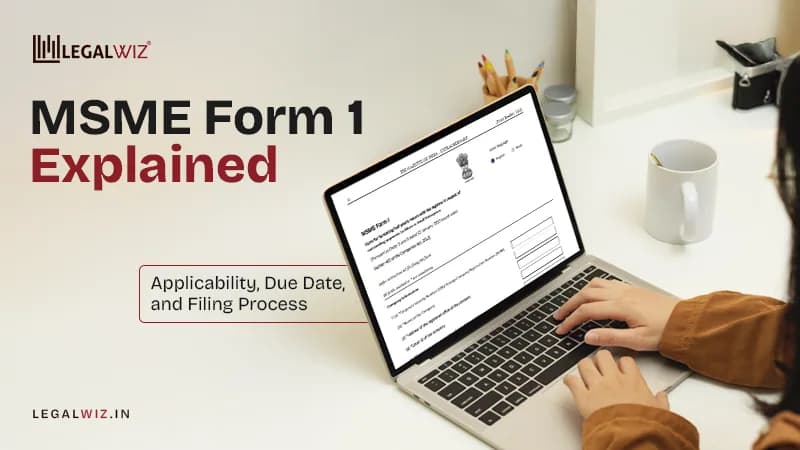
Micro, Small, and Medium Enterprises (MSMEs) are the backbone of India’s economy. They contribute nearly 30% to the GDP and over 45% to exports.
7 min read

Registering a private limited company is a legal process governed by the Companies Act, 2013. While many first-time founders focus on documentation and timelines.
6 min read
No government fee, no renewal, and two working days from start to certificate.
Get started