TAN Card Application: Easy Step-by-Step Online Guide
Published On: Dec 18, 2025 • Last Updated: Apr 6, 2026 • 7.2 min read
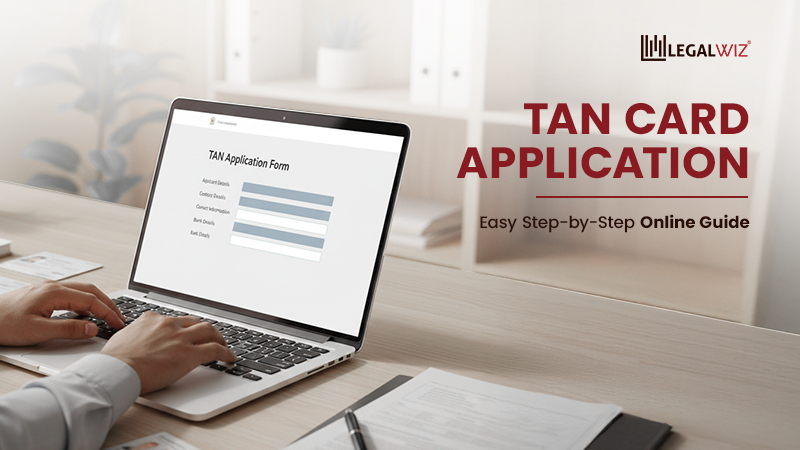
If you’re responsible for deducting or collecting tax at source, completing your TAN application is one of the first steps toward staying compliant. TAN plays a central role in India’s Tax Deducted at Source (TDS) and Tax Collected at Source (TCS) system because every deduction you make, every return you file, and every certificate you issue is tied back to this number. Without it, you can’t submit TDS returns or deposit the tax you’ve deducted, which can lead to avoidable delays and penalties.
A valid TAN helps the government track deducted taxes smoothly, but it also keeps your organisation’s compliance records clean. Whether you’re an individual deductor, a growing business, or a large company handling regular TDS transactions, having a TAN ensures your tax processes run without interruptions.
What is TAN Card and Why Do You Need It?
A TAN, or Tax Deduction and Collection Account Number, is a unique identifier the Income Tax Department assigns to anyone responsible for deducting or collecting tax at source. It’s a ten-character alphanumeric code that links all TDS and TCS-related activities back to the deductor. Whenever you deposit TDS, file quarterly returns, or issue a certificate to the payee, this number is mandatory.
In India, obtaining a TAN isn’t optional if you’re deducting or collecting tax. The law requires individuals, companies, firms, trusts, government offices, and other entities that handle TDS or TCS to apply for it. TAN helps standardise how these taxes are tracked and processed, making sure the government receives accurate information and the deductor stays compliant.
Many people still mix up PAN and TAN when they start handling tax compliance. If you want a quick comparison that breaks down how both numbers work, check out our blog on PAN and TAN in India: Full Form, Meaning, and Key Differences
Who Should Apply for TAN Card? Eligibility Criteria
TAN is needed for anyone responsible for deducting or collecting tax at source, no matter how big or small the organisation is. This applies to individuals running a business, companies, firms, LLPs, trusts, NGOs and even government departments. Whenever a payment falls under TDS or TCS rules, the deductor has to apply for TAN before making any deductions.
Foreign entities operating in India or making payments subject to TDS also need a TAN, even if they already have a PAN. In short, anyone handling tax deduction or collection at source needs this number to stay compliant and carry out related filings without disruption.
When starting with tax compliance, many people confuse TDS and TCS. Both deal with tax at source but apply in different cases. This guide explains the basics clearly: TDS vs TCS in India: Key Differences, Meaning & Rates
Step-by-step process to apply for TAN
TAN application can be done completely online through the NSDL TIN portal. The process is straightforward once the steps are clear. Below is a clean breakdown of each stage so tax deductors can complete the application without delays.
A. Paperless fully online TAN application (using DSC)
- Visit the NSDL TIN portal and choose TAN → Apply online → DSC based TAN application.
- Pick the correct category for the applicant (company, individual, firm, etc.).
- Fill the online Form 49B with the applicant’s details (name, address, AO code and other required fields).
- Attach the Digital Signature Certificate (DSC) of the authorised signatory and sign the form digitally.
- Make payment (only online payment is available for DSC-based submissions).
- On successful submission, you’ll get a 14-digit acknowledgement number. Save this for tracking.
- No physical documents or signed acknowledgements need to be sent to NSDL for DSC-based applications.
This route is easier when the authorised signatory already has a functional Digital Signature Certificate. And if you want to understand DSCs better, you can refer to the blog DSC: All about Digital Signature Certificates.
B. Online TAN application without DSC (paper-based online flow)
- Go to the NSDL TIN portal and choose TAN → Apply online (the non-DSC option).
- Select the correct applicant category and complete Form 49B online. Double-check the AO code and name fields—these are common error points.
- Make payment. You can use Demand Draft (DD), cheque or online payment. If paying by DD/cheque, make it in favour of ‘NSDL – TIN’ and payable at Mumbai.
- Generate and print the acknowledgement receipt (it carries the 14-digit acknowledgement number). Sign the printed acknowledgement in the space provided.
- If a left-hand thumb impression was used, get it attested by a Magistrate/Notary/Gazetted Officer under official seal.
- Send the duly signed acknowledgement receipt and payment instrument (if applicable) to the NSDL e-Gov office at the address shown in the form instructions (NSDL Pune office/Mantri Sterling address as per the brochure). Send within the timeline mentioned so the application isn’t rejected.
C. TAN paper application through TIN-FC (TIN Facilitation Centres)
- Obtain Form 49B from the TIN website or at any TIN-FC. Fill the form in BLOCK LETTERS and in English only.
- Ensure the applicant’s address is an Indian address (foreign addresses are not allowed).
- Submit the completed and signed Form 49B at the nearest TIN-FC. No supporting documents are required with the form.
- Pay the processing fee (the brochure lists ₹77 (incl. GST) for counter payment at TIN-FCs). Keep the receipt.
Important filling rules & payment notes (common to all methods)
Here are a few points applicants should keep in mind while completing Form 49B. These help avoid errors and make the TAN Card Application process smoother.
- The applicant’s address must be an Indian address.
- No supporting documents are required when applying for a new TAN through Form 49B.
- Each box in the form should contain only one character, and a blank box should be left after each word.
- If the applicant’s address changes to a different city that falls under a new RCC (Regional Computer Centre), a fresh TAN application must be filed.
- The field for the person responsible for making payment or collecting tax is mandatory wherever applicable.
- For paper applications, the signature should be placed only in the designated box, preferably in black ink, without touching the edges.
- Applicants should read the full guidelines attached to the form or check the TIN website before submitting the application.
- For online applications submitted without a DSC, the signed acknowledgement must be sent to the NSDL office at the Pune address mentioned in the form instructions.
TAN Card Application Fees, Payment Methods, and Timeline
Here’s a clear table that summarises the fee structure, available payment modes, and the expected processing time for a TAN application.
| Category | Details |
| Application Fee | ₹77 (inclusive of GST) Note: Online payments could be subject to additional gateway fees |
| Online Payment Options | Net banking, debit card, credit card, UPI (where available) |
| Offline Payment Options | Demand Draft or cheque in favour of NSDL – TIN, payable at Mumbai |
| Acknowledgement Requirement | Mandatory for applications submitted without a digital signature |
| Dispatch of Acknowledgement | Must be sent to the NSDL office within the given timeline |
| Processing Time | Typically 7–15 working days after NSDL receives the signed acknowledgement |
| Delivery Method | TAN allotment is sent to the communication address provided in Form 49B or they can email the TAN details for online applications. |
The fee is minimal, yet the form requires careful attention to minute details. Even minor errors tend to delay or reject applications. If you wish to apply for TAN without going through such avoidable delays, a little professional assistance can smoothen the process. Our team of professionals can handle these steps on your behalf and can keep everything compliant, so you can focus on running your business.
How to Track TAN Card Application Status Online
It only takes a minute to check your TAN application if you have the acknowledgement number. The Protean eGov portal gives real‑time updates on whether it’s received, processed, or approved.
Step 1: Visit the Protean eGov (NSDL) portal.
Step 2: Under Application Type, choose “TAN – New/Change Request”.
Step 3: Select “Acknowledgement Number” and enter the 14-digit number.
Step 4: Fill in the captcha and click Submit.
Step 5: The status of the TAN application will appear on the screen.
Ensure Timely TAN Application for Seamless Tax Compliance
A timely TAN Card Application makes tax compliance a lot easier. It keeps your TDS and TCS work on track, helps you avoid penalties, and ensures every deduction is recorded the way it should be. Once the application is completed, the rest of the process, filing returns, issuing certificates, and managing records falls into place without unnecessary stress.
Applying early is a simple step that saves time later. And if you want a smoother, more reliable way to get it done, LegalWiz.in can guide you through the process with confidence.
Frequently Asked Questions
What if I lose my TAN card?
You can apply for a duplicate TAN card by submitting a request for “Change/Correction in TAN” through the NSDL or UTIITSL portals. A new card will be issued with the same TAN.
Can branches of companies/banks have separate TANs?
Yes. Branches can apply for their own TANs. In such cases, the application must clearly mention either:
- The name and location of the branch, or
- The designation of the person responsible for deducting/collecting tax.
This ensures proper identification and compliance.
How to change the communication address linked to TAN?
File a “Change/Correction in TAN” application online and update the new address. Once processed, the updated details will reflect in the records.
How soon can I start deducting tax after TAN allotment?
As soon as you receive your TAN, you can start deducting and depositing tax. There’s no waiting period.

Avani Kagathara
Avani Kagathara brings order to legal chaos as a Content Writer at LegalWiz.in. Armed with an accounts and audits background, she has a knack for making complex legal topics feel less intimidating. Fair warning: she's equal parts thoughtful analyst and spontaneous free spirit.