
Inter-State vs Intra-State Supply Under GST: What You Need to Know
GST changed India’s tax landscape when it rolled out on 1 July 2017. It replaced a cluster of indirect taxes and brought them into one unified system.
Sapna ManeUpdated 4 min read
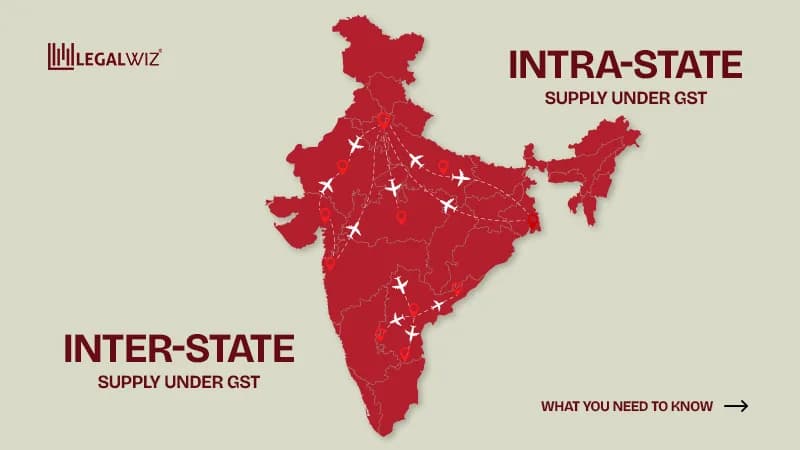
Table of contents9 sections
GST changed India’s tax landscape when it rolled out on 1 July 2017. It replaced a cluster of indirect taxes and brought them into one unified system. While this made compliance more structured, it also introduced a few concepts that every business must understand. One of the most important is the place of supply.
The tax you pay shifts the moment a supply crosses a state border or stays within the same state. That single detail decides whether Integrated Goods and Services Tax (IGST) applies or whether the bill is split between Central Goods and Services Tax (CGST) and State Goods and Services Tax (SGST). It also affects how Input Tax Credit moves through the chain.
This is usually where traders and service providers slow down. The terms interstate and intrastate look similar, yet they carry very different outcomes for pricing, invoicing, and compliance.
If you have searched for inter or intra-state supplies meaning or wondered why the tax split matters, this guide will make the subject much easier to understand if you are planning to get GST registration online or update its details.
Confused about whether you need to register for GST? Under the GST law, any business with an annual turnover above ₹20 lakhs, or ₹10 lakhs in North Eastern states, must obtain a GST registration number. Here’s the blog that explains how to get your GST number with ease: How to Get GST Number Online
What Interstate Supply Means Under GST
A supply becomes interstate when the supplier and the place of supply fall in two different states or Union Territories. GST also treats certain special categories as interstate.
Interstate supply includes:
Supplies between two different states or UTs
Imports into India
Exports from India
Supplies made to or from SEZ units or EOUs
Only IGST applies to these transactions. The Central Government collects IGST, then transfers the destination state’s share through the settlement system. This avoids double taxation and keeps interstate trade simple for businesses.
A company in Gujarat supplying goods to Karnataka is the classic example. The seller charges IGST at the applicable rate, and the tax structure remains uniform across the country.
What Intrastate Supply Means Under GST
A supply becomes intrastate when both the supplier and the place of supply are in the same state. This is the easiest way to understand intra-state supplies. The entire supply must stay within a single state boundary.
The tax splits into two halves:
CGST goes to the Centre
SGST goes to the State
Both rates are equal parts of the total GST rate. Businesses collect both and pay them separately through their GST returns. This ensures the state receives its full share without depending on any central settlement.
To stay compliant once you identify your supply type, you can follow this simple GST compliance checklist for service-based businesses: GST Compliance Checklist for Service-Based Businesses
GST Rate Structure
India’s GST structure as of September 22, 2025, follows these key slabs:
5 percent for standard essentials
18 percent for most goods and services
0 percent for exempt and basic necessities
40 percent for luxury and sin goods
The total rate remains the same whether a supply is interstate or intrastate. Only the division of tax changes.
To understand more about the new GST slabs and how they affect your business or as an individual, refer to our blog: GST Slabs 2025: What Every Buyer and Business Should Know
Basic GST Calculation Formula
You can calculate GST using a simple formula that applies to all GST slabs.
For any GST rate:
GST Amount = Value of Supply × GST Rate
For interstate supplies (IGST):
IGST = Value of Supply × IGST Rate
For intrastate supplies (CGST + SGST):
CGST = Value of Supply × (GST Rate ÷ 2)
SGST = Value of Supply × (GST Rate ÷ 2)
This structure keeps the total tax the same for both interstate and intrastate transactions. Only the split between IGST, CGST, and SGST changes.
Interstate GST Example
Consider a company in Jaipur shipping mobiles worth ₹1,00,000 to Mumbai. Since the goods move from Rajasthan to Maharashtra, the supply becomes interstate.
GST impact:
GST rate: 18 percent
IGST charged: ₹18,000
Tax paid to the Centre, which is later transferred to Maharashtra’s share
Supplies to SEZ units follow the same rule. Even if the SEZ lies within the same state, the supply is treated as interstate.
Intrastate GST Example
Now consider a supply within Rajasthan. ABC Ltd in Jaipur sells mobiles worth ₹2,00,000 to a business in Udaipur.
GST impact:
GST rate: 18 percent
Total GST: ₹36,000
CGST: ₹18,000
SGST: ₹18,000
The total GST charged equals the IGST rate, but the split differs.
Key Differences Between Interstate and Intrastate GST
Here is a clear comparison:
Parameter | Interstate Supplies | Intrastate Supplies |
Meaning | Supplier and place of supply are in different states/UTs | Supplier and place of supply are in the same state |
Type of tax | IGST | CGST + SGST/UTGST |
Levied by | Central Government | Centre and respective State/UT |
Revenue share | Destination state gets share of IGST | State keeps full SGST |
Place of supply | Different from supplier’s location | Same as supplier’s location |
Input Tax Credit | IGST credit can be used for IGST, then CGST or SGST | CGST and SGST credit cannot cross-adjust |
SEZ treatment | Always interstate | Not applicable |
Interstate Vs Intrastate Supply: Why This Distinction Matters
Understanding whether a supply is interstate or intrastate helps businesses:
Charge the correct GST on invoices
Claim Input Tax Credit correctly
File accurate GST returns
Avoid notices, interest, or penalties
Maintain cleaner accounts and better cash flow
It also keeps compliance smooth for companies operating in multiple states.
Read the full blog here to understand about GST and Tax credit here: All about GST and Tax Credit Online Sellers
Conclusion
Interstate and intrastate supplies form the core of India’s GST system. The rule is simple. If the supplier and the place of supply lie in different states, the supply becomes interstate and attracts IGST. If both lie within the same state, the supply becomes intrastate and attracts CGST and SGST. Once this distinction is clear, including the true intra-state supplies meaning, GST compliance becomes far easier to manage. If you want reliable assistance with GST registration, filing GST returns, or business compliance, LegalWiz can help. Our experts ensure that the procedural work is handled smoothly, so you can focus on running your business.
Frequently asked questions
What is the main difference between inter-state and intra-state supply?
Inter-state supply happens when the supplier and the place of supply are in different states. Intra-state supply happens when both are in the same state.
What does intra state supplies meaning refer to?
It refers to any supply made within one state. These transactions attract CGST and SGST.
Are supplies to SEZ considered inter-state?
Yes. Supplies to or from an SEZ are always treated as inter-state and attract IGST.
How is GST charged on inter-state supply?
Inter-state supply attracts IGST, collected by the Centre and later shared with the destination state.
How does ITC work for inter-state and intra-state?
IGST credit can be used for IGST, CGST, or SGST. CGST and SGST credits can be used within their own categories but cannot be cross-adjusted.
Why does this classification matter?
It decides the type of GST to charge, affects invoice accuracy, and ensures correct claim of Input Tax Credit.

Written by
Sapna Mane is a skilled content writer at LegalWiz.in with years of cross-industry experience and a flair for turning legal, tax, and compliance chaos into clear, scroll-stopping content. She makes sense of India’s ever-changing rules—so you don’t have to Google everything twice.
All articles by Sapna ManeServices related to this article
Everything here is handled online by our specialists, start to finish.
Comments