
Copyright Registration Process: Step-by-Step Procedure Guide
A simple, practical walkthrough of the copyright registration process in India, from documents and fees to filing, objections, and getting the certificate.
Ankit Pandya5 min read
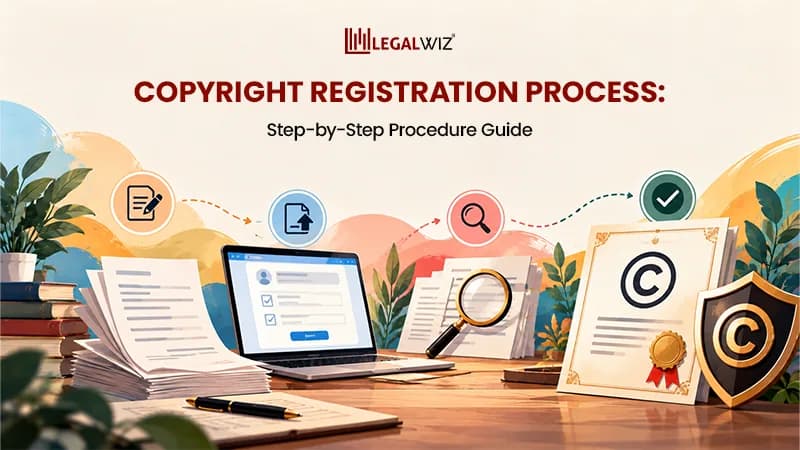
Table of contents12 sections
In a world of Ctrl+C and Ctrl+V, watching your hard work show up on someone else’s website is almost a rite of passage.
The good news?
You don't need a golden government stamp to prove they pinched it.
You can, and you never needed a certificate to earn that right. Copyright in India begins the moment you create an original work. Registration is optional. What it gives you is proof, and proof is what people ask for when someone denies the work is yours.
This guide explains how to get a copyright in India, what the registration process involves, and where applications usually go wrong.
Registration Is Optional, Proof Is Not
Section 45 of the statutory rules governing copyright India states that a work "may" be registered, meaning registration isn't mandatory to own your work. . Courts have accepted that you can sue without a certificate.
Now picture this: someone steals your content and claims they created it first. Without a certificate, it’s just your word against theirs. But under Section 48, your registration entry acts as prima facie evidence in court. That means you walk in with legal proof, not just an angry argument. It also makes things much easier down the line when you need to license your work, sell your rights, or show ownership papers to an investor.
One myth worth clearing up. Posting a copy of your work to yourself is not registration, and the Act gives it no standing.
What Copyright Covers
Copyright covers the expression, not ideas. Anyone can write about digital marketing. The topic belongs to nobody. Copy another writer's exact article, though, and that is a copyright issue.
Type of work | Examples |
Literary | Book, blog, article, manual, software code |
Dramatic | Script, play, screenplay |
Musical | Song, composition, lyrics |
Artistic | Painting, photograph, design, logo artwork |
Cinematograph film | Movie, video, advertisement, web series |
Sound recording | Music track, podcasts, audiobooks |
Who Owns What
In copyright law, creation equals ownership. The only major exception is work made by an employee, which usually goes straight to the employer. Freelance work is where people get caught off guard.
A client might pay a designer for a new logo and use it everywhere, assuming it's theirs. But unless there's a signed agreement handing over the rights, the designer still legally owns the artwork.
The client pays, uses it everywhere and assumes it owns the logo. Without a written, signed assignment under Section 19, the designer can still be the legal owner.
So settle the applicant before you file. If the applicant is not the author, you generally need a no-objection letter from the author, or the assignment itself. If someone files on your behalf, a power of attorney may be needed.
One Work, One Application
This is where many filings go wrong. A book, its cover design and its promotional video are three works. That means three applications and three fees.
Software splits the same way. The source code is a literary work. The logo of the product is an artistic work.
Documents to Keep Ready
Most filings involve these:
A copy of the work (source code, in the case of software)
Author and applicant details
A no-objection letter from the author, if the applicant is someone else
The assignment deed or agreement, if rights were transferred
Publication details, if the work is already published
A search certificate from the Trade Marks Registry, for a logo or any artwork used on goods or services
Government Fees
Work category | Fee per work |
Literary, dramatic, musical or artistic work | Rs. 500 |
Sound recording | Rs. 2,000 |
Artistic work used on goods or services | Rs. 2,000 |
Cinematograph film | Rs. 5,000 |
Fees get revised now and then, so confirm the current figures on copyright.gov.in before you pay.
How to File Online
The full process for copyright registration in India runs through the Copyright Office portal, using Form XIV under the Copyright Rules, 2013.
Create an account. Register as a new user, log in and choose online copyright registration.
Fill Form XIV. It asks for the title, category and language of the work, author and applicant details, and the dates of creation and publication. There is a Statement of Particulars, plus a Statement of Further Particulars where it applies. Get the title and category right, because a vague title or the wrong category invites a query. Names should read the same everywhere. If the form says "Rajesh Kumar" and the assignment says "R. Kumar", expect a letter from the Registrar.
Upload and pay. Attach the work and your papers. Blurry scans delay things. Once the fee is paid you get a diary number. Save it along with the receipt, because every status check uses it.
After Payment, the Waiting Starts
For 30 days after filing, anyone who claims an interest in the work can raise an objection. You are also expected to send a copy of your application to anyone who might have such a claim. If nobody objects, the file goes to examination.
If the Registrar has questions, or someone has objected, you get 30 days to reply. Miss that window and the application can be treated as abandoned, which means a fresh filing and a fresh fee. Some cases go to a hearing, where proof of ownership matters.
Once everything clears, the work is entered in the Register of Copyrights and the certificate appears on the portal. You can track progress with the diary number under Diary Status.
How Long Does It Take?
There is no fixed answer. Most people wait a few months. Clean applications with clear ownership move faster. Missing consent, a weak copy of the work, an objection or a hearing slows things down. So does a discrepancy letter left unopened for weeks.
How Long Does Protection Last?
You will see "60 years" on many websites, and that is only half the story. For literary, dramatic, musical and artistic works, protection runs for the author's lifetime plus 60 years after death. For photographs, films, sound recordings and anonymous works, it is 60 years from the start of the calendar year after publication.
Doing It Yourself, or With Help
One author, one literary work, and the author is the applicant: you can reasonably file that yourself.
Add a company, a co-author, an assignment, source code or a logo, and the paperwork gets fussier. If you want a second pair of eyes on the form before it goes in, that is what we do at LegalWiz.
Frequently asked questions
How do I get a copyright in India?
Create an original work, prepare the work copy and ownership documents, file Form XIV through the Copyright Office e-filing portal, pay the government fee, respond to any deficiency or objection, and receive the registration certificate after approval.
How do you obtain a copyright without registration?
Copyright arises automatically when an original work is created and fixed in a tangible form. Registration is not compulsory, but it provides strong documentary proof of ownership.
What is the government fee for copyright registration in India?
The fee is Rs. 500 for most literary, dramatic, musical, or artistic works. It is Rs. 5,000 for a cinematograph film and Rs. 2,000 for a sound recording.
Can I register copyright for software?
Yes. Software is generally treated as a literary work for copyright purposes. You can file the source code or relevant portions as part of the application.
Is copyright registration mandatory in India?
No. Copyright protection begins automatically with the creation of an original work. Registration is optional but highly useful as legal evidence.
Can two people jointly own a copyright?
Yes. Co-authors can jointly own copyright if they created the work together with the intention that their contributions would be merged into one work.
What happens if someone objects to my copyright application?
The Copyright Office may schedule a hearing. Both sides can submit evidence and arguments. The Registrar decides whether the work should be registered.
Does copyright protection last forever?
No. In India, copyright generally lasts for the lifetime of the author plus 60 years after death. The calculation can differ for certain categories such as films, sound recordings, and anonymous works.
Written by
Content & Marketing Manager
Ankit Pandya is a marketing and content strategist with 8 years of experience across FMCG, D2C, and B2B. He writes about content strategy, digital marketing, AI-driven growth, and emerging industry trends, combining practical insights with real-world marketing experience.
All articles by Ankit PandyaServices related to this article
Everything here is handled online by our specialists, start to finish.
Comments