
GST Registration Documents for Proprietorship
GST registration is usually the first tax compliance step for a proprietorship. Because the business and the owner are legally the same, the application relies heavily on accurate documents.
Avani KagatharaUpdated 5 min read
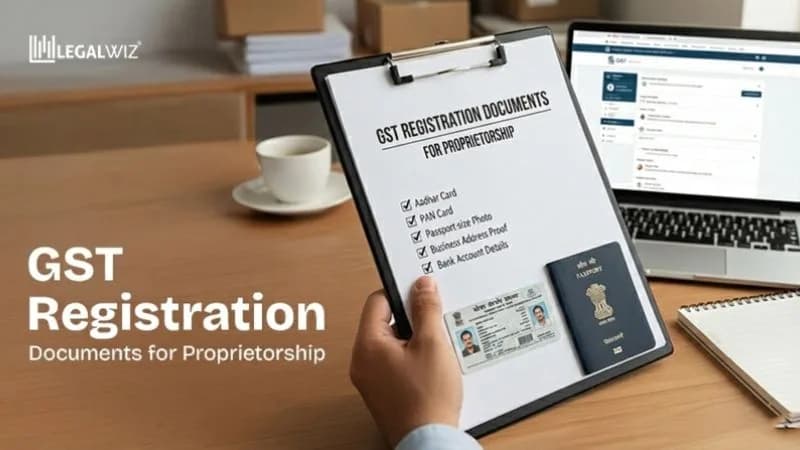
Table of contents12 sections
GST registration is usually the first tax compliance step for a proprietorship. Because the business and the owner are legally the same, the application relies heavily on accurate documents. Even small mistakes in details or uploads can slow down approval or result in avoidable queries from the department.
Understanding the GST registration documents for proprietorship in advance makes the process far simpler. When proprietors know which papers are required, why they are asked for, and how they connect to the business, GST registration becomes a straightforward task rather than a repeated back-and-forth with the portal.
What is GST Registration?
GST registration is the process through which a business is brought under the Goods and Services Tax system. It allows the business to operate legally and comply with GST rules.
After registration, the proprietor receives a GST Identification Number (GSTIN), which is required to:
Charge GST on goods or services
File GST returns on time
Claim eligible input tax credit
For a proprietorship, GST registration is directly linked to the owner. Since there is no separate legal entity, the approval is based on the proprietor’s details along with the business information provided during registration.
Eligibility for GST Registration for Proprietorship
A proprietorship must apply for GST registration when it falls within the limits or categories defined under GST law. The requirement is based on the nature of business and how it operates.
GST registration becomes mandatory in the following cases:
The business turnover crosses the prescribed GST threshold limit
The proprietor is involved in inter-state supply of goods or services
Sales are made through e-commerce platforms
The business falls under categories notified for compulsory registration
Even when turnover is below the limit, registration may still be required if the activity attracts mandatory GST compliance.
Understanding eligibility first helps proprietors avoid unnecessary filings and ensures the GST registration documents for proprietorship are prepared correctly before starting the application.
This section covers the basic eligibility rules, but GST requirements can go beyond these points. In real situations, factors like the nature of work, how supplies are made, and where the business operates can change the requirement. To understand these cases better and avoid confusion, you can read our detailed blog on Understanding Eligibility for GST Registration.
List of GST Registration Documents for Proprietorship
The documents fall into three main categories. Each serves a specific verification purpose.
1. Identity and Address Proof of the Proprietor
Since a proprietorship has no separate legal identity, GST registration is linked directly to the owner. The following details are required to confirm the proprietor’s identity:
PAN card of the proprietor (mandatory)
Aadhaar card of the proprietor
Recent passport-size photograph
Email ID and mobile number linked with Aadhaar
For GST purposes, the proprietor’s PAN is used as the PAN of the business.
2. Proof of Business Address
Business address proof is required to show where the proprietorship operates from. The documents vary based on the nature of the premises.
If the place is owned:
Property tax receipt, electricity bill, Municipal Khata copy, or water bill
Ownership document, if available
If the place is rented or leased:
Rent or lease agreement
Latest utility bill of the premises
No-objection certificate (NOC) from the owner, if required
If the place is shared or belongs to a family member:
Consent letter from the owner
Utility bill of the premises
This is one of the most closely checked documents for GST registration for proprietor, so consistency in address details is important.
3. Bank Account Details
GST registration requires proof that the business has an active bank account in the proprietor’s name.
Accepted documents include:
Cancelled cheque with proprietor’s name
Bank statement (first page)
Passbook copy
The bank account may be a savings or current account, as long as it belongs to the proprietor.
4. Proof of Business Registration
While a proprietorship is not separately registered as a legal entity, certain documents are often accepted as proof of business existence.
Commonly accepted documents include:
Shop and Establishment Certificate
Trade license issued by the local authority
Any government-issued registration showing the business name
These documents help support the business details provided during GST registration, especially when the trade name differs from the proprietor’s personal name.
Additional Supporting Documents (If Applicable)
Some businesses may need extra documents based on their activity or registration type.
These may include:
Letter of Authorization (if someone else files on behalf of the proprietor)
Digital signature (DSC), in specific cases
While not always mandatory, these help strengthen the application.
GST Registration Process for Proprietorship
GST registration for a proprietorship is completed online by submitting business details and documents in a structured manner.
The application starts on the GST portal, where the proprietor chooses the option for new registration and enters basic information such as PAN, legal name, and state.
After submitting these details, verification is done through OTP sent to the registered mobile number and email ID. Once verified, the application moves forward.
Next, the proprietor fills in the business information such as the trade name, business address, and nature of activities. These details should match the supporting documents to avoid issues later.
After the application is filled, an application reference number is generated. This number is used to track the progress of the GST registration until approval.
The required documents are then uploaded on the portal. Clear and correct uploads are important, as most delays happen at this stage due to mismatches or unclear files.
The GST department reviews the application and documents. If anything additional is needed, a notice is raised on the portal.
After successful verification, the GST Identification Number (GSTIN) is issued and can be downloaded from the GST portal.
The steps above explain the GST registration process at a basic level. To apply with more clarity, it helps to know what happens at each stage and how applications are reviewed. For a clearer understanding, you can go through our detailed guide on GST registration for sole proprietorship.
Common Mistakes to Avoid During GST Registration for Proprietorship
Many applications get delayed due to avoidable errors.
Mismatch between PAN and Aadhaar details
Unclear or outdated address proof
Bank documents without printed name
Uploading incorrect file formats or sizes
Double-checking your GST registration documents for proprietorship before submission saves time.
Final Thoughts
Getting GST registration approved is less about complexity and more about accuracy. When your documents required for GST registration for proprietorship are clear, valid, and consistent, the process becomes smooth and predictable. For proprietors who do not want to spend time dealing with portal errors or repeated clarifications, getting help can simplify the process. LegalWiz assists with online GST registration by handling documentation, filing, and follow-ups until the GSTIN is issued, allowing business owners to stay focused on their work.
Frequently asked questions
Can I use my home address for GST registration?
Yes. A home address can be shown as the business address as long as proper address proof is provided.
Is a current account required for GST registration?
No. GST registration can be completed using a savings account held in the proprietor’s name.
Is PAN mandatory for GST registration of a proprietorship?
Yes. GST registration cannot be completed without the proprietor’s PAN.

Written by
Avani Kagathara brings order to legal chaos as a Content Writer at LegalWiz.in. Armed with an accounts and audits background, she has a knack for making complex legal topics feel less intimidating. Fair warning: she's equal parts thoughtful analyst and spontaneous free spirit.
All articles by Avani KagatharaServices related to this article
Everything here is handled online by our specialists, start to finish.
Comments