
Trademark Form 48: Power of Attorney for IP India
Why your trademark agent needs this authority on record before anything gets filed, and what the Registry expects today
Ankit Pandya4 min read
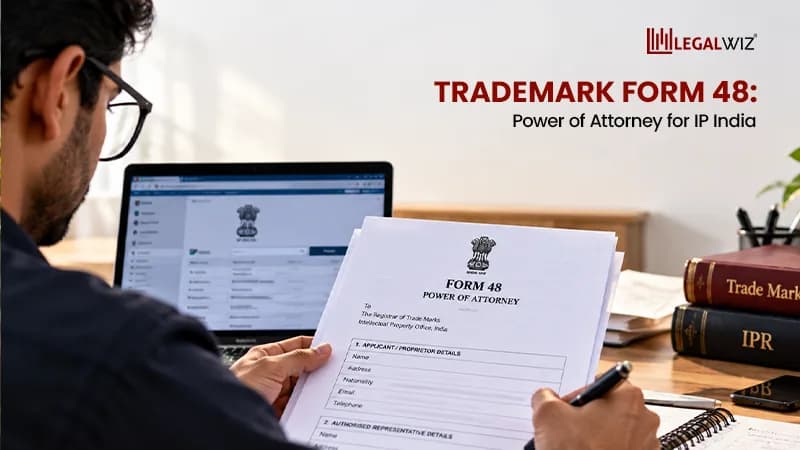
Table of contents12 sections
Form TM-48 is the power of attorney a trademark applicant signs so that an agent or advocate can file and handle the application at IP India on their behalf. If someone other than you is filing, the Registry wants to see this authority. Without it, the application can get stuck on a formality objection.
There is a catch most blogs skip. TM-48 belongs to the old Trade Marks Rules, 2002. Under the Trade Marks Rules, 2017, Rule 19 says an agent’s authorisation is executed in Form TM-M. So on paper the name has changed. In daily practice, agents, clients and search engines still say “TM-48” for the same document.
Short answer, then. You would need a signed, dated authority naming a specific agent or advocate, stamped as per your state’s law, and it goes along-with your trademark application. The rest of this post explains each part.
What is the importance of Form 48?
It empowers your agent to do the process for you. It allows them to file the application, reply to reports sent by examination officer, attend hearings, file an opposition, renew the mark later. Whatever you have authorised.
The legal weight sits in Rule 19(2).
Once an agent is authorised, any document served on the agent is treated as served on you. The Registry writes to your agent, and your agent appears in your place.
So read it before you sign. If you hand over a trademark objection reply to an expert, that expert gets the notices, not you.
And a missed hearing is not a small thing. If nobody appears on the date and no reply has been filed, the Registrar can treat the application as abandoned. When you take up trademark registration through an agent, ask who is tracking those dates.
TM-48 and TM-M, side by side
Form TM-48 | Form TM-M | |
|---|---|---|
Under which rules | Trade Marks Rules, 2002 (Rule 21) | Trade Marks Rules, 2017 (Rule 19) |
Status today | Old name, still used in everyday talk | Prescribed form for agent authorisation |
Legal base | Section 145, Trade Marks Act, 1999 | Section 145, Trade Marks Act, 1999 |
Purpose | Authorise an agent | Authorise an agent (TM-M also covers other requests) |
Same job. Newer paperwork.
Who can you appoint?
Section 145 lets you act through a legal practitioner or a registered trade marks agent. The older form text also mentioned a person in your sole and regular employment.
One more thing. An earlier Registry manual said a power of attorney in favour of a firm, with no individual named, should not be accepted. So write the person’s name, even if they work at a firm.
Who signs it?
The applicant signs. For a company or LLP, an authorised signatory signs, and it helps to keep the board resolution or authority letter ready in case the Registry asks. Rule 19(3) also says the Registrar can still ask for your personal signature or presence in a particular case.
Powers of attorney for other purposes, say a property or banking matter, are a different document altogether. You can get those drafted through our power of attorney service.
Stamp duty: the confusing bit
Search this form online and you will find ₹100, ₹500, ₹1,000, even “plain paper is fine”. We came across all four while writing this post.
None is right everywhere. Stamp duty is varies statewise, hence the amount depends on where the document is signed. Consult your agent which value applies in your state, and use an e-stamp if your state allows it. Do not copy a number from a blog, this one included.
Mistakes that cause trouble
Firm name written, no individual agent named
Applicant name not matching the application exactly
No date, or no signature
Stamp paper of the wrong value or from the wrong state
A scan so blurry nobody can read it
A missing or faulty authority can bring a formality objection. We have a separate guide on what the formality check fail status means and how to fix it.
How it gets filed
Your agent files online on the IP India e-filing portal and attaches the authority there. If you want to see what else travels with it, our list of documents required for trademark registration covers the full set.
The same logic applies later. If an agent files your trademark renewal, the authority needs to be on record for that too.
Changing or cancelling the agent
Sign a fresh authorisation in favour of the new agent. Simple enough.
But watch Rule 19(4) and (5). If your application shows no principal place of business in India, you must give an address for service in India within two months of the agent withdrawing or you revoking. Miss that window and the application is deemed abandoned. Easy to overlook.
Do you need it if you file on your own?
No. Self-filing needs no power of attorney. The trade-off is that every notice comes straight to you, and every date is yours to track.
What this looks like in practice
One of our trademark clients, Vishvam PG, mentioned in his June 2026 Google review that filing took around three days and the team stayed connected throughout. Three days is realistic when the paperwork, authority included, is right the first time.
Before you sign
Check the agent’s name. Check the stamp value. Check your own name against the application. Then sign. If you want to see where this fits in the whole journey, our trademark registration process guide walks through every stage.
Frequently asked questions
Do I need a power of attorney if I file my trademark myself?
No. It is needed only when an agent or attorney acts for you.
Can I appoint a firm instead of a person?
Name an individual agent or advocate. An earlier Registry manual did not accept authority in favour of a firm alone.
Does it need stamp paper or notarisation?
Stamp duty depends on your state, so check the correct value with your agent. Competitor pages disagree on this, so rely on your agent’s confirmation for your state.
How do I cancel or change my agent?
Execute a fresh authorisation in favour of the new agent. If your application lists no principal place of business in India, give an address for service in India within two months, or the application can be deemed abandoned.

Written by
Content & Marketing Manager
Ankit Pandya is a marketing and content strategist with 8 years of experience across FMCG, D2C, and B2B. He writes about content strategy, digital marketing, AI-driven growth, and emerging industry trends, combining practical insights with real-world marketing experience.
All articles by Ankit PandyaServices related to this article
Everything here is handled online by our specialists, start to finish.
Comments